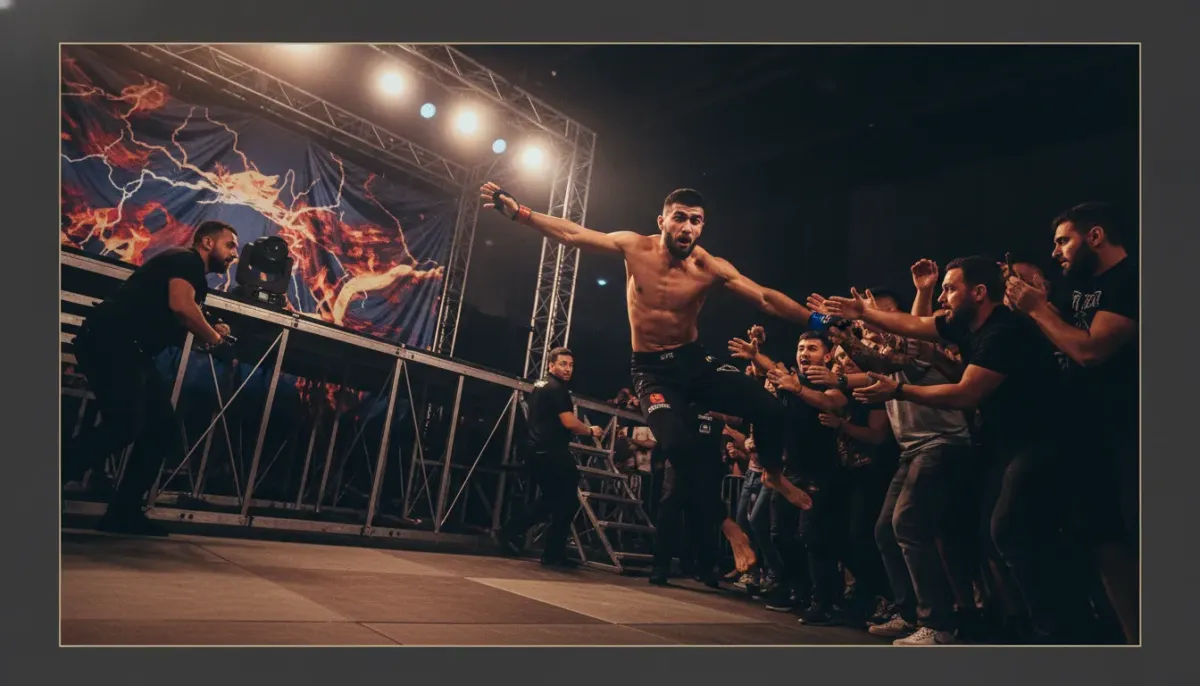
The Dramatic Takedown That Sent Both Wrestlers Flying
RAF 8 witnessed a stunning moment when Arman Tsarukyan attempted an aggressive takedown on Urijah Faber that resulted in both competitors tumbling off the elevated stage onto the concrete surface below. The sequence unfolded rapidly during an intense wrestling exchange, with Tsarukyan driving forward in pursuit of a match-deciding maneuver. Despite the alarming nature of the fall from an elevated platform, neither athlete sustained serious injuries, allowing the competition to resume shortly after the incident.
The impact of this unexpected moment reverberated across combat sports media, generating significant attention for the RAF promotion. What began as a technical wrestling sequence transformed into an unscripted, dangerous moment that tested both the athletes' resilience and the organization's safety protocols. The fact that both competitors walked away without major injuries added an element of fortune to an otherwise precarious situation.
Tsarukyan's Dominant Performance
Prior to the stage incident, Tsarukyan had already established complete control over the match through superior wrestling technique and positioning. He entered the takedown attempt already ahead on the scorecards, seeking to secure a decisive advantage. Following the dramatic fall and return to competition, Tsarukyan executed another takedown and landed a powerful four-point throw, extending his lead to an commanding 13-1 margin. This performance ultimately secured victory through technical superiority, the freestyle wrestling equivalent of a dominant decision, ending the match well before time expired.
Tsarukyan's Perspective on the Controversial Moment
Instinctive Combat Over Deliberate Intent
During the post-event press conference, Tsarukyan addressed the stage incident directly, emphasizing that the fall was not a calculated or intentional action. He explained that his wrestling instincts operate automatically during competition, with aggressive movements flowing from muscle memory and competitive drive rather than premeditation. According to his statement, the momentum and intensity of the moment overwhelmed conscious decision-making, resulting in the unplanned catastrophe.
Tsarukyan's explanation highlighted the difference between recklessness and the natural consequences of high-intensity grappling exchanges. He portrayed himself as an athlete whose competitive nature occasionally produces unexpected outcomes, distinguishing between conscious malice and the spontaneous nature of elite wrestling competition. This framing attempted to separate the incident from any suggestion of intentional wrongdoing toward his opponent.
Recognizing the Positive Outcomes
Beyond his self-defense explanation, Tsarukyan acknowledged the fortunate outcome that no serious injury occurred. He expressed gratitude that Faber avoided significant harm while simultaneously recognizing that the viral nature of the incident generates substantial promotional value. Tsarukyan openly discussed how dramatic, shareable moments like this amplify attention not only for individual athletes but for the entire RAF organization and combat wrestling as a sport.
This candid acknowledgment revealed Tsarukyan's understanding of modern sports dynamics, where spectacular and unusual moments drive engagement across social media platforms and traditional sports media outlets. He positioned the incident as beneficial for wrestling's visibility, suggesting that such unexpected moments serve the broader interests of the sport's growth and popularity.
The RAF Executive's Critical Response
Official Disapproval and Safety Concerns
RAF executive Izzy Martinez responded to the incident with clear displeasure, characterizing the action as unprofessional and problematic. Martinez openly criticized the decision to force Faber off the stage, describing it as a "dirty" move that violated standards of competitive conduct. The executive expressed concern that such uncontrolled aggression, regardless of intent, creates unnecessary risks for athletes and undermines the integrity of the competition.
Martinez's critique went beyond simple disapproval, suggesting that if Tsarukyan intended to throw Faber, a controlled throw would have been preferable to pushing him off an elevated platform. The executive's perspective emphasized that athletes should have reasonable opportunity to protect themselves during competition, a principle violated when an opponent lacks warning of impending danger.
Balancing Entertainment Value Against Integrity
Despite his personal disapproval, Martinez acknowledged the promotional reality that the incident generated viral attention and media coverage. He demonstrated awareness of the paradox facing modern combat sports organizations: dramatic moments drive viewership despite potentially compromising competition standards. Martinez stated clearly that while he personally dislikes such incidents, he recognizes their role in generating organic promotional content.
This nuanced stance revealed the tension within RAF between capitalizing on attention-grabbing moments and maintaining professional standards. The executive's comments suggested that organizational success increasingly depends on tolerating incidents that fall into gray areas between sport and entertainment, even when those responsible for oversight find such moments ethically questionable.
Tsarukyan's History of On-Stage Drama
Previous Controversial Incidents
The stage incident with Faber represents the latest in a pattern of dramatic moments associated with Tsarukyan's RAF appearances. Most notably, his rivalry with Georgio Poullas produced significant controversy when Tsarukyan threw Poullas to the ground immediately after winning their match, then threw a punch that ignited a full-scale brawl involving multiple personnel. That incident demonstrated Tsarukyan's tendency to blur the line between competition and confrontation, creating unpredictable situations that extend beyond standard wrestling exchanges.
These repeated incidents have established Tsarukyan as a polarizing figure within RAF, generating both fascination and concern. His unpredictability has become a defining characteristic, with promoters and fans anticipating that his appearances might produce unexpected drama. This reputation precedes him into each competition, shaping how audiences and officials perceive his actions.
The Marketability-Liability Balance
Tsarukyan's pattern of controversial moments presents RAF with a genuine organizational dilemma. His matches consistently generate higher engagement and media coverage due to the expectation of dramatic developments. However, this appeal comes with significant risks, including potential athlete injuries, legal liability, and questions about his professionalism that could extend to perceptions of his conduct in other combat sports contexts.
The organization must continuously weigh whether the promotional benefits of Tsarukyan's unpredictability justify the inherent risks and reputational concerns. As his reputation becomes more established, each new incident contributes to a broader narrative about his suitability as a standard-bearer for the sport.
Implications for RAF and Combat Wrestling's Future
Organizational Challenges and Strategic Considerations
RAF faces ongoing challenges in managing athletes like Tsarukyan who operate in the space between calculated competition and uncontrolled chaos. The organization must implement safety protocols that protect athletes while preserving the organic drama that draws audiences. This requires careful navigation of liability concerns, athlete welfare standards, and the inherent unpredictability that makes such performers valuable.
The incident with Faber demonstrates that traditional safeguards may prove insufficient when dealing with high-intensity grappling near elevated platforms. RAF must evaluate whether current stage design and safety measures adequately protect competitors from unexpected falls while maintaining the visual spectacle that defines the promotion's presentation.
Tsarukyan's Broader Professional Standing
Tsarukyan's dual role as a top-ranked UFC lightweight contender and an active RAF wrestler creates unique dynamics. His conduct in wrestling receives scrutiny not only from RAF officials but from UFC stakeholders concerned about how his behavior reflects on the broader combat sports community. The question remains whether his reputation for dramatic incidents will eventually influence how serious organizations perceive his professionalism and reliability as a competitor.