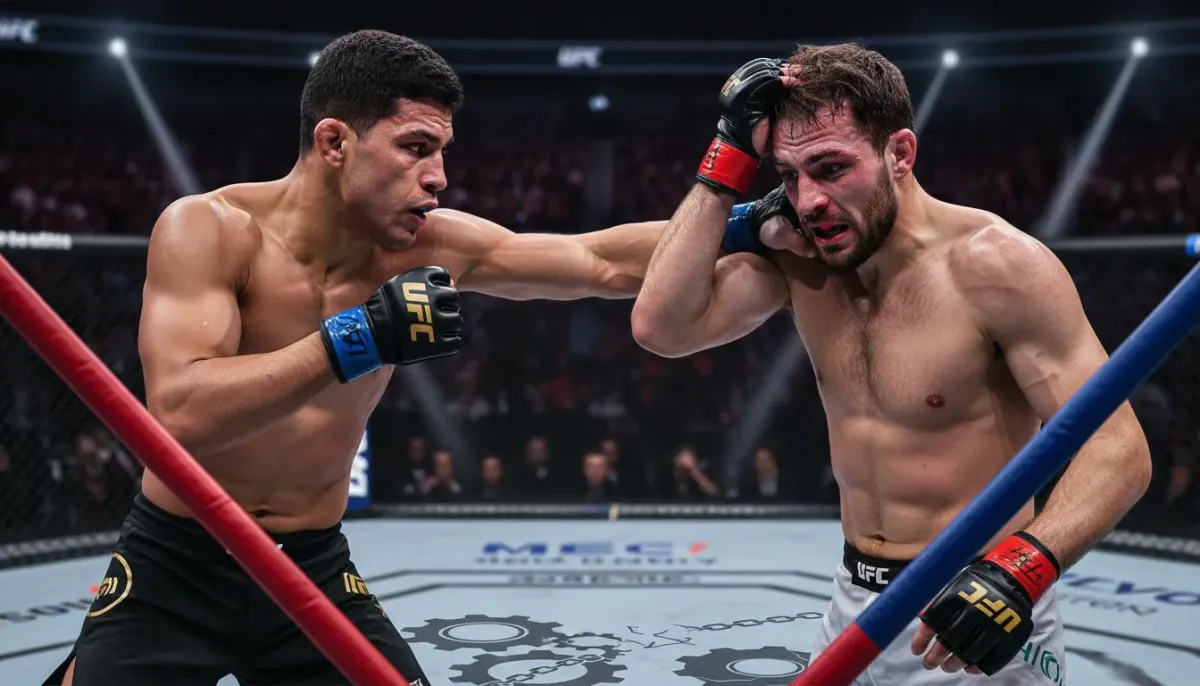
Caio Borralho delivered a comprehensive performance at UFC 326 that not only secured his victory but also highlighted troubling signs in his opponent. The Brazilian fighter's dominant three-round display against Reinier de Ridder left UFC leadership questioning the Dutch grappler's mindset, sparking discussions about the psychological dimensions of elite-level combat competition.
The Dominant Performance That Reignited Borralho's Title Hopes
Borralho's victory at UFC 326 represented far more than a single win—it was a statement of intent. Fighting to a unanimous decision, the Brazilian fighter showcased a complete skill set that positions him squarely in the middleweight title conversation. His record now stands at an impressive 8-1 inside the UFC, establishing him as a legitimate contender for championship consideration.
What made the performance particularly noteworthy was Borralho's tactical approach. He didn't rely on a single strategy but instead displayed versatility across all ranges. When standing, he consistently landed the more impactful strikes, demonstrating superior precision despite trading overall volume with de Ridder. When the action moved to the canvas, Borralho showed no hesitation in engaging a submission specialist, controlling the tempo and minimizing dangerous positions.
This three-round masterclass effectively silenced any lingering doubts about Borralho's championship credentials. His ability to adapt and execute across multiple facets of the sport reflects the evolution of a fighter rapidly ascending the divisional rankings.
What Happened to the Champion? De Ridder's Uncharacteristic Performance
De Ridder's performance raised eyebrows from the opening bell. The two-time title challenger suffered his second consecutive loss, a troubling development for someone of his caliber. Beyond the result, observers noticed something fundamentally different about his approach and engagement throughout the contest.
The physical element of de Ridder's game remained intact—he landed strikes, attempted submissions, and showed flashes of his technical prowess. However, there was an unmistakable lack of intensity and presence that characterized his previous performances. Rather than the aggressive, forward-moving fighter fans knew, de Ridder appeared subdued and reactive. His usual ability to impose his will seemed absent, replaced by a more tentative approach.
This performance marked a significant departure from how de Ridder typically competes. The gap between the version of himself he displayed and his established capabilities became impossible to ignore, prompting serious questions about his psychological state heading into this bout.
Dana White's Candid Assessment: "Didn't Look Like the Same Guy"
UFC President Dana White's post-fight observations cut straight to the heart of the matter. Rather than focusing solely on Borralho's technical superiority, White addressed what he perceived as a fundamental issue with de Ridder's motivation and mental preparation. At the UFC 326 press conference, White stated plainly that something felt fundamentally different about the fighter's approach.
Such candid commentary from leadership reflects the organization's expectations regarding fighter performance standards. When a prominent figure questions an athlete's engagement level, it signifies that the absence of mental readiness is evident even to casual observers. This wasn't a case of tactical adjustment or stylistic mismatch—it was about whether de Ridder was truly present for the fight.
White's observations carry weight in professional combat sports, where psychological preparation is considered equally important as physical conditioning. His remarks essentially validated what viewers and commentators sensed: something fundamental was amiss with de Ridder's approach to this contest.
Borralho's Perspective: Energy as a Weapon
Following his victory, Borralho offered his own analysis of what transpired. The Brazilian fighter believes that psychological presence and energy played a crucial role in the fight's dynamic. He suggested that de Ridder's mental state had been compromised throughout fight week, not merely in the octagon itself.
Borralho's confidence in his own preparation and mental sharpness was palpable. He emphasized being fully present and engaged throughout the week, contrasting his approach with de Ridder's apparent withdrawal. This confidence wasn't arrogance but rather an understanding that combat sports operate on multiple levels—physical, technical, and psychological.
The idea of "energy" as a tangible factor in fighting experience is increasingly recognized in elite MMA circles. Borralho's commentary suggests that his mental clarity and positive engagement created an environment where de Ridder felt overwhelmed, potentially exacerbating any existing doubts or lack of motivation he harbored.
The Week Leading Up to UFC 326: Tension Below the Surface
Borralho's analysis pointed to the promotional week as the period when de Ridder's disengagement became apparent. Media obligations, press conferences, and fight-week activities can be mentally taxing, particularly for fighters dealing with internal conflicts or motivation issues. De Ridder's withdrawal from typical promotional duties suggested something deeper was troubling him.
The fighter's reluctance to engage during media sessions foreshadowed his octagon performance. Borralho noted that when given opportunities to exchange words at press conferences, de Ridder declined, indicating his mental state was already compromised. This pattern of disengagement over several days can't simply be attributed to fight-week nerves—it suggests something more profound was affecting de Ridder's mindset.
The atmosphere surrounding fighters during promotional duties often sets the tone for their performance. When a fighter appears withdrawn and unmotivated during these obligations, it frequently translates to similar behavior inside the cage, a principle that appeared to hold true in this instance.
Borralho's Assessment of De Ridder's Inner Game
Despite his victory and observations about de Ridder's mental state, Borralho offered a nuanced perspective. He theorized that de Ridder may have been motivated by an internal desire to prove something personal, possibly related to his recent defeats. This internal struggle, rather than disrespect or disinterest, might explain some of the tension between them.
Borralho also distinguished between the perception of de Ridder as a fighter who quits and the actual capabilities of Reinier de Ridder when fully engaged. While de Ridder ultimately showed up mentally at UFC 326, it was a compromised version of himself, not the fighter Borralho would have preferred to face at his peak.
This distinction reveals Borralho's understanding that testing himself against the absolute best version of his opponent carries more value. Defeating a diminished de Ridder, while significant, didn't provide the complete validation that a victory against peak de Ridder would have offered.
Striking and Grappling Mastery: Borralho's Complete Toolkit on Display
Perhaps the most impressive aspect of Borralho's victory was his demonstration of well-rounded excellence. On the feet, despite de Ridder maintaining respectable strike volume, Borralho's precision and power were noticeably superior. Every exchange seemed to favor the Brazilian's positioning and timing.
On the ground, Borralho fearlessly engaged against a submission specialist, a tactical choice that could have proven costly against a mentally sharp de Ridder. Instead, it showcased Borralho's grappling credentials and unwillingness to shy away from challenging areas of his opponent's game.
This combination of striking refinement and grappling confidence solidified Borralho's status as a complete mixed martial artist. Middleweight contenders can no longer rely on single-dimensional strengths when facing him—they must be prepared for excellence across the entire technical spectrum.
What's Next for Both Fighters?
Borralho's path forward appears clear: a middleweight championship opportunity should materialize soon given his recent performance and divisional standing. His combination of ranking position and recent dominant victory positions him as a logical next challenger.
For de Ridder, the situation demands serious introspection. Two consecutive losses, with the second showing apparent mental disengagement, raises questions about his psychological resilience and championship-caliber readiness. Recovery from this setback will require not only physical preparation but also genuine assessment of what drove his performance degradation.