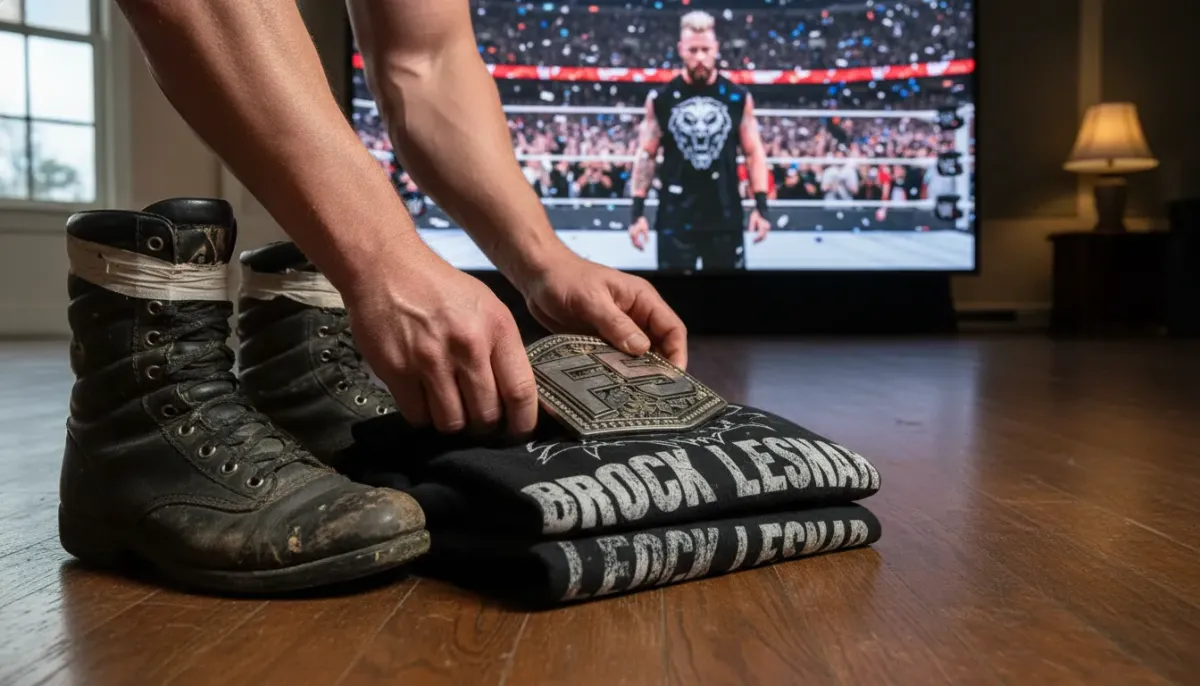
In a poignant moment that marked the end of an extraordinary athletic journey, Brock Lesnar officially retired from professional wrestling following his match at WrestleMania. The 48-year-old veteran executed the time-honored tradition of removing his gloves and boots, placing them ceremonially in the center of the ring—a symbolic gesture recognized across combat sports to signify the conclusion of a competitor's career. As Lesnar embraced his longtime manager Paul Heyman, the crowd erupted in an emotional chorus of "Thank you, Lesnar," honoring decades of dominance across multiple fighting disciplines.
The End of an Era at WrestleMania
Lesnar's farewell performance came during the opening match of night two at WWE's premier annual event, where he faced Oba Femi. The ceremonial removal of his wrestling attire was not merely a theatrical flourish but a meaningful conclusion to a legendary tenure in professional wrestling. The tradition of leaving boots and gloves in the ring carries deep significance in combat sports, particularly among athletes with backgrounds in collegiate or international wrestling, signifying both respect for the sport and a formal departure.
The emotional weight of the moment was amplified by notable figures in attendance, including former UFC heavyweight champion Daniel Cormier, who witnessed firsthand Lesnar's final appearance. The audience's heartfelt appreciation underscored the profound impact Lesnar had maintained throughout his career in sports entertainment.
From College Dominance to Professional Wrestling
The Foundation: Collegiate Wrestling Excellence
Lesnar's foundation was built on exceptional collegiate wrestling achievements, where he captured an NCAA championship while representing the University of Minnesota. This prestigious accomplishment opened doors to professional opportunities, leading him to WWE where he underwent developmental training through regional promotions. His progression to the main roster proved meteoric—Lesnar quickly established himself as one of the organization's marquee attractions, commanding audience attention and main event positioning.
However, the demands of professional wrestling took their toll. By 2004, a combination of physical injuries and psychological burnout compelled Lesnar to step away from WWE, setting the stage for an unexpected transition into combat sports.
The NFL Opportunity That Slipped Away
Following his departure from wrestling, Lesnar pursued what many athletes consider the ultimate achievement: a career in professional football. He pursued an opportunity with the Minnesota Vikings, seeking to transition his athletic prowess into America's most popular sport. When this NFL ambition failed to materialize, Lesnar pivoted toward mixed martial arts, a decision that would ultimately define his legacy more than his wrestling departure.
The UFC Chapter: From Outsider to Champion
Breaking Into Elite Mixed Martial Arts
Lesnar's entry into mixed martial arts began modestly with a single appearance under the K-1 banner, where he secured an impressive first-round victory. However, pursuing opportunities with the UFC proved significantly more challenging. Dana White, the UFC's visionary leader, initially showed no interest in signing the unknown wrestler, refusing to return calls from Lesnar's representatives.
Undeterred, Lesnar employed an unconventional but memorable strategy. After fighting at the Los Angeles Coliseum for K-1, he purchased nosebleed-section tickets to a UFC event at the MGM Grand, where Randy Couture was defending his heavyweight championship. Following Couture's victory, Lesnar scaled security barriers, rushed into the octagon, and introduced himself directly to Dana White. This bold approach resonated with White, who granted him a one-fight promotional deal.
From Debut to Heavyweight Champion
Lesnar's UFC debut against Frank Mir resulted in defeat, yet the promotion recognized exceptional potential. His ability to generate mainstream interest and drive substantial viewership numbers convinced UFC leadership to retain him despite the loss. This decision proved prophetic—within nine months of his debut, Lesnar defeated Randy Couture to claim the UFC heavyweight championship, cementing his status as a generational talent in mixed martial arts.
The Return to Wrestling and Final Chapter
Back to Professional Wrestling (2012 Onward)
Lesnar maintained an extraordinary run in professional fighting while preserving his connection to wrestling. In 2012, he rejoined WWE as a full-time competitor, reclaiming his position among the promotion's elite athletes. Rather than pursuing an intensive schedule, Lesnar adopted a selective appearance model, participating in high-profile events while maintaining focus on his MMA obligations and personal pursuits. This strategy kept him relevant within professional wrestling's landscape while preventing overexposure.
The 2018 Tease and Ultimate Decision
In 2018, Lesnar briefly flirted with a return to active UFC competition, generating speculation about one final chapter in mixed martial arts. However, he ultimately reaffirmed his commitment to retirement from fighting, choosing instead to concentrate on periodic professional wrestling appearances. His most recent stint culminated with this WrestleMania performance, bringing his storied wrestling career to a respectful and ceremonial close.
A Legacy Spanning Multiple Combat Sports
Few athletes in history have achieved elite status across as many combat disciplines as Brock Lesnar. His dominance in collegiate wrestling, credibility as an NFL prospect, championship-caliber performance in mixed martial arts, and sustained drawing power in professional wrestling represents an achievement that transcends individual sports. Lesnar's career trajectory demonstrates the remarkable athletic versatility possible when exceptional physical gifts combine with determined ambition and adaptability. His retirement marks the conclusion of one of combat sports' most distinctive and influential careers.