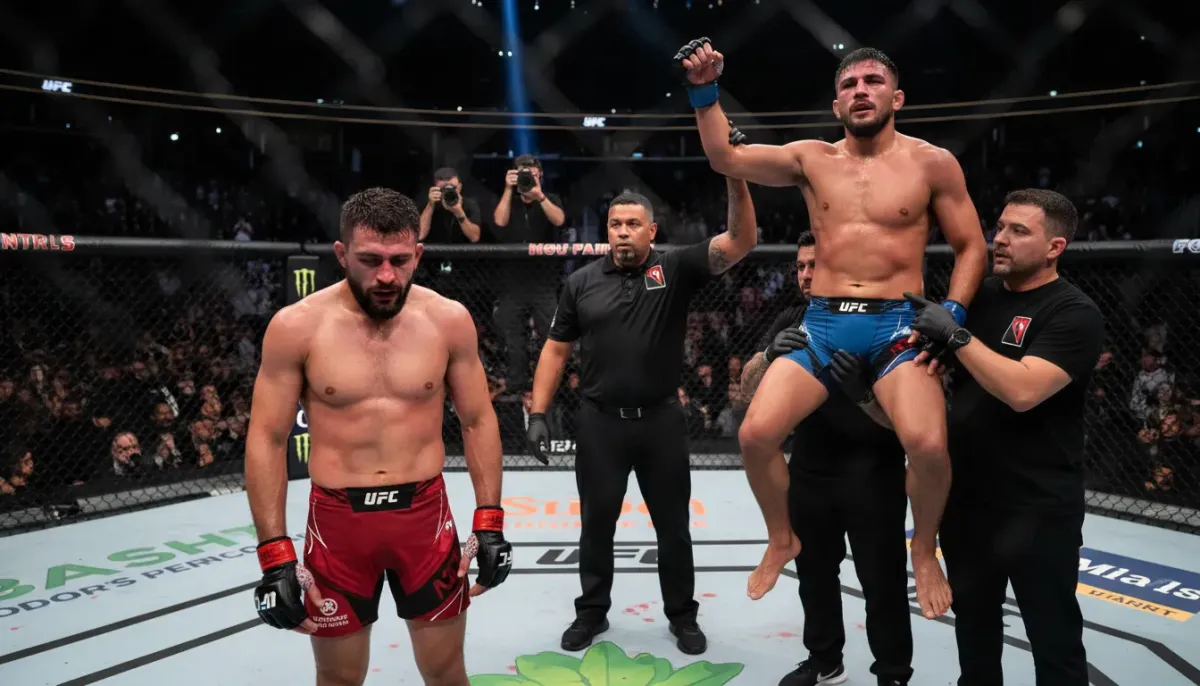
The UFC Vegas 114 card delivered mixed entertainment value when Chris Curtis faced Myktybek Orolbai in a welterweight matchup that highlighted the ongoing tension between effective grappling and fan engagement. Curtis, known as "The Action Man," found himself on the wrong side of a lopsided unanimous decision, leading to pointed post-fight commentary about his opponent's fighting approach.
The Fight That Wasn't: Curtis' Frustration After One-Sided Loss
Curtis expressed his disappointment through colorful language following the defeat, describing the experience with blunt honesty. The veteran fighter acknowledged that while he entered the bout well-prepared physically, the strategic approach adopted by his opponent fundamentally altered the nature of the competition. Curtis' knee remained healthy throughout, and his training camp had gone exceptionally well, eliminating any physical excuses for the outcome.
What truly frustrated the 46-fight veteran was the passive nature of the engagement. Curtis emphasized that fighting an opponent with minimal offensive intent creates an entirely different dynamic than a traditional striking or balanced exchanges. His post-fight assessment reflected not anger toward Orolbai specifically, but rather disappointment with the overall quality of the spectacle. Despite the loss, Curtis sustained no physical injuries, though his pride certainly took a hit from the scorecards showing clear dominance in Orolbai's favor across all three rounds.
Orolbai's Record-Breaking Grappling Display
Myktybek Orolbai's performance at UFC Vegas 114 will be remembered for its sheer wrestling dominance. The Kazakhstani fighter executed an exceptional grappling gameplan that resulted in 19 successful takedown attempts, establishing a new UFC welterweight record in this statistical category. This remarkable achievement underscored Orolbai's superior wrestling credentials and his ability to implement a suffocating control strategy.
Beyond the raw numbers, Orolbai demonstrated exceptional grip strength and positional awareness that kept Curtis pinned throughout the contest. Rather than pursuing submissions or ground-and-pound opportunities, Orolbai maintained control, preventing Curtis from establishing any momentum or offensive sequences. This methodical approach, while effective from a competitive standpoint, essentially removed the variable of exchanging technique from the equation. Orolbai's three-round performance has clearly elevated his standing within the welterweight division and demonstrated that his wrestling foundation provides a formidable pathway to victory at this competition level.
A Rare Weakness for the Veteran "Action Man"
Throughout his extensive career, Curtis has typically found answers to various fighting styles, but Orolbai's specialized wrestling-centric approach exposed a notable vulnerability in his defensive grappling capabilities. With 46 professional fights on his resume, Curtis has encountered numerous grapplers, yet this particular matchup proved distinctly troublesome. The inability to escape or reverse Orolbai's takedowns repeatedly highlighted a gap in Curtis' wrestling defense.
Curtis' assessment of his own performance reflected professional objectivity. He acknowledged that while his physical conditioning held up and he sustained no injuries, his strategic preparation fell short against this specific opponent type. This represents a significant finding for a veteran fighter accustomed to navigating diverse competitive challenges. The lesson here extends beyond a single loss—it suggests that Curtis may need to recalibrate his approach when facing opponents who employ relentless ground control strategies with minimal offensive intent.
The Bigger Picture: Curtis' Recent Struggles
This defeat arrives during a concerning stretch for Curtis. Since returning to the welterweight division, he has compiled a 1-1 record while losing three of his past four fights overall. This trajectory raises legitimate questions about his continued competitive window at this level of professional competition. For a fighter of Curtis' experience and historical competitiveness, this pattern suggests potential challenges in either skill development or matchup compatibility.
The frequency of these losses against varied opponents indicates that Curtis may be encountering stylistic mismatches more regularly than earlier in his career. Whether this reflects the natural aging process, increased competition levels, or simply unfortunate matchmaking remains an open question. Nevertheless, the statistical reality demands attention and potential strategic adjustments in his career path moving forward.
Grappling vs. Entertainment: A Recurring Debate in MMA
The Curtis-Orolbai matchup exemplifies a persistent tension within modern mixed martial arts. Orolbai's strategy was objectively effective—he won decisively by dominating one specific dimension of combat. However, the minimal offensive output from either fighter created a technical rather than dramatic experience for viewers. Curtis' public criticism reflects a broader conversation about the balance between winning strategy and audience engagement.
This debate lacks simple resolution. From a competitive standpoint, Orolbai executed his game plan flawlessly and secured a legitimate victory. From an entertainment perspective, extended periods of positional control without submission attempts or significant damage represent a less captivating product. Both perspectives hold validity, and fighter perspectives like Curtis' help illuminate how competitors perceive different stylistic approaches to winning fights.
What's Next for Both Fighters
Orolbai enters his next challenge with considerable momentum. His three consecutive victories, combined with this record-setting performance, position him as an ascending welterweight threat. The fighter's confidence following this dominant display suggests he will continue implementing wrestling-heavy strategies in future matchups, particularly if opponents struggle to counter his grappling approach.
For Curtis, the crossroads moment has arrived. His extended career and veteran status normally provide flexibility in adaptation, yet recent results suggest such adjustments may prove increasingly difficult. Whether Curtis pursues additional welterweight opportunities, considers a weight class change, or evaluates his continued competitive involvement represents a decision with significant career implications. His extensive experience and acknowledged fighting heart suggest he retains options, though the current trajectory demands prompt tactical evolution.