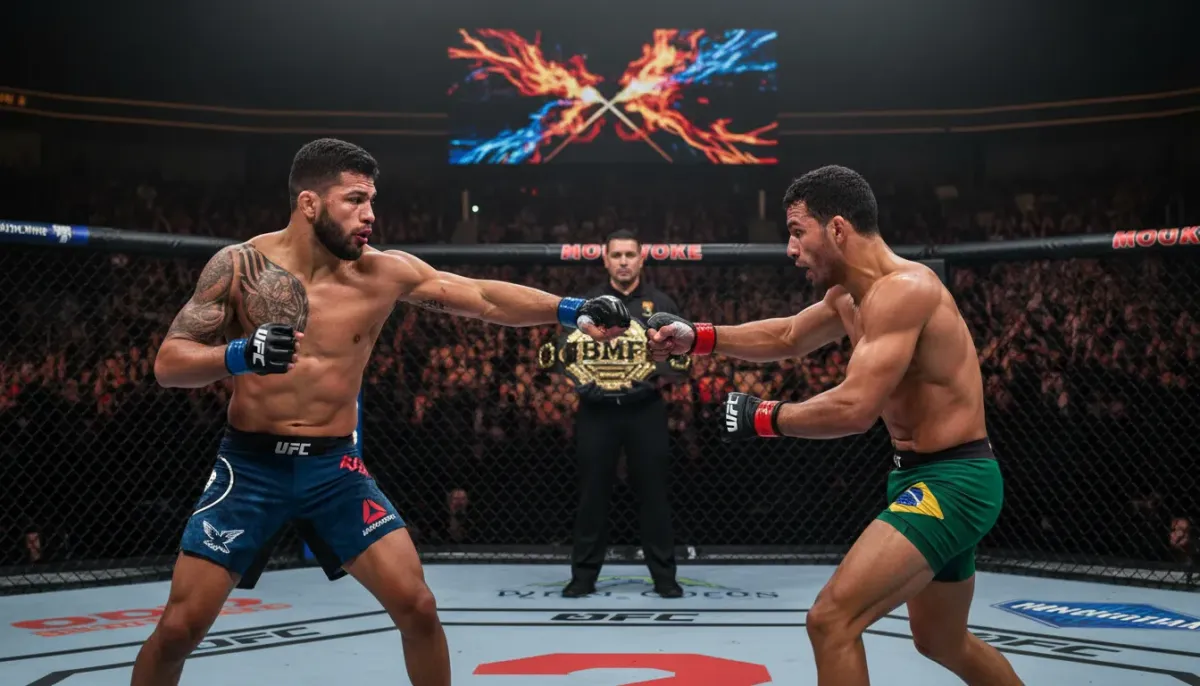
A Long-Awaited Rematch Between Two MMA Legends
The UFC 326 main event brings together two of combat sports' most decorated fighters in a matchup that transcends the typical championship bout. Max Holloway and Charles Oliveira's rivalry finally reaches its conclusion on the sport's biggest stage, with the BMF championship hanging in the balance. This isn't simply another title fight—it's a clash between two athletes whose careers have defined an entire generation of mixed martial arts excellence.
The original encounter between these fighters dates back to August 2015 at UFC Saskatoon, where Holloway secured victory under unfortunate circumstances when Oliveira suffered an injury that forced the contest's premature conclusion. More than a decade later, fans finally get the opportunity to witness a definitive resolution to their rivalry. Both fighters have evolved dramatically since that first meeting, transforming into the elite-level competitors who now command respect throughout the sport.
The stakes extend far beyond personal redemption. A victory at UFC 326 positions the winner for a subsequent opportunity at an undisputed championship belt. For both Holloway and Oliveira, this represents potentially their final realistic pathway to securing another undisputed title opportunity, making this encounter a pivotal moment in their respective legacies.
Max Holloway's Evolution Into a Champion
From Featherweight Greatness to BMF Recognition
Holloway's ranking among the sport's elite continues to reflect his consistent dominance and historical significance. His featherweight reign established him as one of the most formidable champions the division has ever witnessed. The accolades from his championship era remain impressive: successful title defenses against some of the sport's finest competitors including Jose Aldo, Dustin Poirier, Justin Gaethje, Frankie Edgar, and The Korean Zombie, among numerous other elite-level opponents.
What distinguishes Holloway is his remarkable ability to maintain excellence across extended periods. His victories showcase technical progression, strategic depth, and the capacity to adapt against diverse fighting styles. These qualities didn't vanish when he transitioned away from the featherweight division—they remained central to his identity as a competitor.
The BMF Championship Achievement
Holloway's capture of the BMF championship represents perhaps the most remarkable achievement of his career's later stage. His knockout victory over Justin Gaethje at UFC 300 demonstrated that his striking remains as sharp as ever, occurring in the bout's final moments and capping an absolutely dominant performance. This triumph elevated his legacy considerably, providing validation that he remains among the sport's most dangerous competitors.
The distinction of being the only fighter to successfully defend the BMF championship further solidifies Holloway's status among mixed martial arts' most accomplished athletes. His subsequent victory over longtime rival Dustin Poirier showcased his continued ability to overcome elite-level opposition. This momentum enters UFC 326, where Holloway arrives as the betting favorite yet faces an opponent who presents unique challenges.
Charles Oliveira's Submission Legacy and Recent Journey
Building an Unmatched Submission Record
Charles Oliveira, known professionally as "Do Bronx," has constructed perhaps the most impressive submission legacy in UFC history. His unmatched record for submission victories distinguishes him as a technician without peer in the organization's ground fighting hierarchy. This skillset represents the foundation of his identity as a competitor and the primary mechanism through which he has accumulated victories against elite opponents.
Oliveira's technical mastery on the ground demonstrates meticulous preparation and an almost supernatural understanding of positional grappling. Opponents consistently find themselves in precarious situations when Oliveira gains dominant positioning, facing the perpetual threat of submission that forces them into reactive rather than proactive fighting positions.
The Lightweight Championship Achievement and Recent Performance
Oliveira achieved a career milestone by capturing the undisputed lightweight championship at UFC 262, defeating Michael Chandler for the vacant belt. This accomplishment represented the culmination of years of consistent excellence and technical development, positioning him among the sport's most celebrated champions. However, subsequent performance has proven inconsistent, with a 5-3 record since that championship victory.
Despite these mixed results, Oliveira continues delivering memorable moments in victory and defeat alike, producing highlight-reel submissions and dramatic finishes that captivate audiences. An UFC 326 victory would reset his championship narrative, providing legitimate justification for another undisputed title opportunity at a division where his grappling prowess remains virtually unmatched.
Analyzing the Stylistic Matchup
Striking Excellence Versus Grappling Mastery
The fundamental contrast between these fighters creates a compelling stylistic puzzle. Holloway brings superior striking capabilities, lighter footwork, and speed advantages that allow him to control distances and dictate exchanges from the striking realm. His boxing combinations flow naturally, and his defensive awareness against incoming offense remains exceptional.
Conversely, Oliveira operates from the grappling framework, seeking takedowns that position him advantageously on the ground where his submission expertise becomes virtually undefendable. His wrestling proficiency and ground control mechanics have troubled numerous elite opponents throughout his professional career. The fight's outcome hinges significantly on whether Holloway can maintain sufficient distance to leverage his striking while Oliveira works to implement his grappling strategy.
Key Determining Factors
Betting markets recognize this matchup as notably closer than initial positioning suggested. Holloway entered as a favorite, yet analytical perspectives acknowledge Oliveira's legitimate victory pathways. Holloway must execute tactical striking while avoiding extended grappling exchanges. Oliveira requires successful takedown conversions early in rounds to accumulate advantage before Holloway's cardio and striking volume potentially overwhelm him in the contest's later stages. This fundamental tension between their strengths and weaknesses defines what promises to be a compelling contest.
Historical Context: The Original 2015 Encounter
When these fighters first collided in 2015, neither had achieved the heights they would subsequently reach. Holloway emerged victorious in a featherweight bout, but circumstances prevented fans from witnessing a complete contest. Oliveira's injury forced a premature conclusion, leaving both fighters and audiences without definitive proof of superiority. This unresolved element has lingered across eleven years of their respective developments.
Both competitors have transformed dramatically since that initial meeting. Holloway established himself as a featherweight great and subsequently moved up in weight classes. Oliveira ascended to lightweight championship status before experiencing the rollercoaster of success and setback that characterizes his recent trajectory. The 2015 version of these fighters bears little resemblance to the current iterations, making the rematch genuinely meaningful rather than simply nostalgic.
Championship Implications and Legacy Consequences
The victor at UFC 326 positions himself favorably for undisputed championship consideration at both the lightweight and potentially featherweight divisions. For Holloway, victory strengthens his case as one of mixed martial arts' most complete fighters, demonstrating that his achievements transcend a single weight class or era. For Oliveira, triumph provides the narrative foundation necessary to argue for another lightweight title opportunity despite recent inconsistency.
Both fighters' Hall of Fame candidacy only strengthens through success at this stage of their careers. Each victory represents validation that these athletes remain capable of competing at the absolute highest levels despite the years invested in their sport. The winner emerges as a potential future champion, while the loser still maintains sufficient credibility for top-tier opportunities given their historical accomplishments.