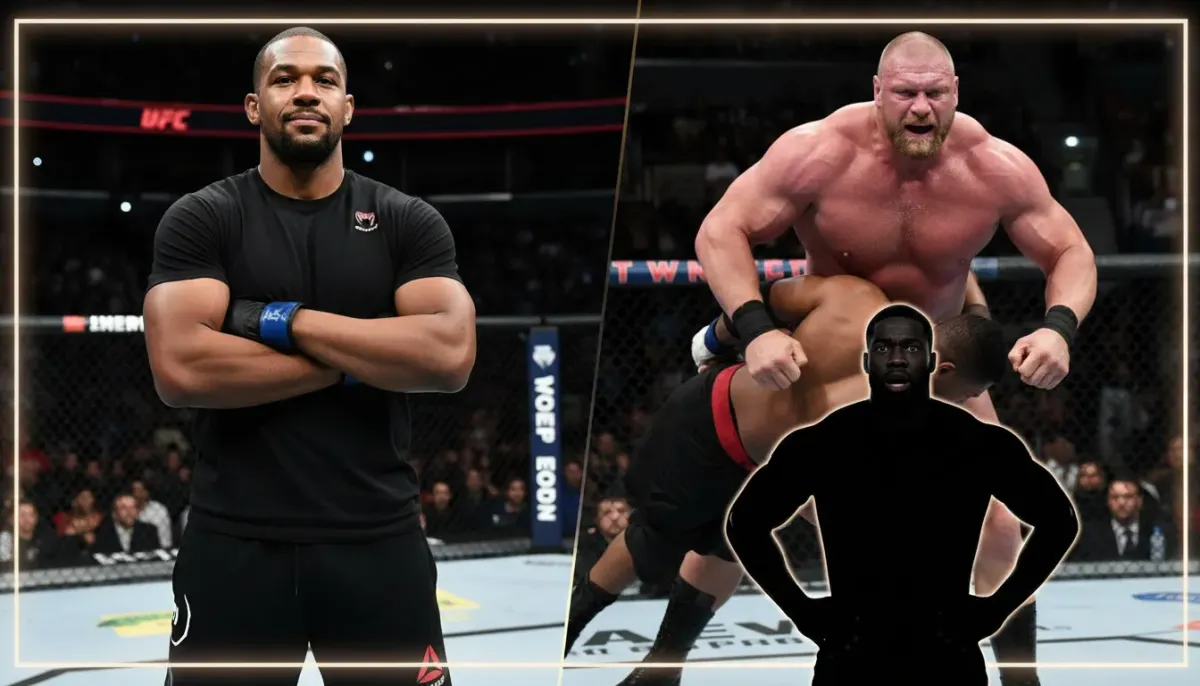
In the world of mixed martial arts and combat sports, hypothetical matchups between elite competitors frequently spark heated debates among fighters and fans alike. Recently, Kamaru Usman made a striking prediction that drew immediate attention from Jon Jones, igniting a social media exchange centered around a fascinating "what-if" scenario involving pure wrestling competition.
Usman's Analysis: The Case for Lesnar's Wrestling Dominance
Kamaru Usman, a respected voice in the combat sports community, offered his assessment of how Brock Lesnar would fare against Jon Jones in a pure wrestling match at a hypothetical RAF event. Usman's reasoning centered on the physical and strategic advantages that Lesnar's heavyweight frame would provide in a grappling-only format.
Understanding Usman's Reasoning
Usman acknowledged that while Jones possesses superior offensive wrestling capabilities, Lesnar's exceptional physical attributes would prove decisive in pure wrestling competition. The key factors in Usman's analysis included Lesnar's substantial limb length, his ability to maintain an upright stance against takedown attempts, and his proficiency in hand-fighting—a crucial skill that prevents opponents from securing effective positions on larger opponents.
Usman emphasized how the weight class differential creates distinct wrestling dynamics. At heavyweight, where Lesnar competed during his UFC career, hand control and clinch positioning operate under different principles than at middleweight where Jones traditionally competed. Usman believed that shooting underneath someone of Lesnar's size and maintaining control would present formidable challenges, even for an elite grappler like Jones.
Jones' Immediate and Confident Rebuttal
The former dual-division UFC champion wasted no time responding to Usman's assessment. Jones discovered the analysis on social media and delivered a characteristically confident retort, declaring he would secure victory against both Usman and Lesnar simultaneously in such a matchup.
The Champion's Perspective
Jones' response reflected the supreme confidence that typically characterizes elite combat athletes. His willingness to dismiss Usman's prediction against both opponents simultaneously demonstrated the competitive mindset required to reach the pinnacle of professional fighting. Rather than engaging in a detailed technical analysis, Jones opted for a statement that emphasized his wrestling pedigree and overall dominance in grappling situations.
This exchange illustrates a common dynamic in combat sports: elite athletes instinctively reject unfavorable hypothetical scenarios, viewing them as challenges to their legitimacy rather than legitimate strategic assessments. Jones' credentials as a dominant grappler across multiple weight divisions provide substantial foundation for his confidence.
The Context Surrounding Jones' Career Trajectory
Understanding this exchange requires examining Jones' recent career developments and his current standing within the UFC landscape. Jones has navigated considerable uncertainty regarding his competitive status and future opportunities in professional fighting.
Recent Developments and Uncertainty
Jones vacated his UFC heavyweight title during the previous year, creating speculation about potential retirement from competition. However, his subsequent re-entry into the promotion's drug-testing pool signaled renewed interest in competing at the highest levels. This decision followed significant developments in the broader political landscape that created opportunities for championship events at unprecedented venues.
The timing of this wrestling debate coincided with periods of flux in Jones' career, when questions about his immediate future in the octagon remained unanswered. His engagement with Usman's prediction demonstrated that despite uncertainty about formal competition timelines, his competitive fire remained undimmed.
The Hypothetical RAF Wrestling Format
A pure wrestling event format at an RAF venue would represent a unique testing ground for grappling supremacy. Unlike traditional mixed martial arts competition, such an event would eliminate striking, submissions, and other martial arts techniques, creating an environment where wrestling mechanics operate in isolation.
This format would fundamentally alter strategic considerations compared to MMA. Fighters would have no defensive mechanisms beyond wrestling itself, potentially changing how elite competitors approach grappling sequences. The appeal of such pure wrestling formats lies in their ability to isolate and evaluate specific martial arts skills without the complexity of multimodal combat systems.
Lesnar's Standing in Combat Sports History
Brock Lesnar occupies a unique position in combat sports, having competed at the highest levels of both UFC and professional wrestling. His NCAA Division I wrestling background provided a substantial foundation for his dominance during his UFC heavyweight championship tenure.
Lesnar's Competitive Legacy
Lesnar's victories in the octagon often showcased his elite wrestling and ground control abilities. His submission defense proved remarkably effective, allowing him to dominate opponents through positional wrestling rather than striking exchanges. His recent transition toward professional wrestling with WWE represents a shift in his competitive priorities, though speculation about potential return opportunities occasionally surfaces.
The ongoing intrigue surrounding Lesnar stems from the historical significance of his achievements and the enduring question of how his skills would translate in contemporary competition against current elite heavyweights.
Wrestling Formats and Their Competitive Implications
The debate between Usman and Jones touches upon fundamental questions about grappling dynamics across different rule sets and competitive formats. Pure wrestling environments create unique advantages and disadvantages compared to mixed martial arts contexts.
In MMA, submission threats and striking capabilities influence how grapplers position themselves and pursue advantages. Wrestling-only formats eliminate these variables, potentially disadvantaging fighters whose ground control relies on implicit threats rather than wrestling positioning itself. This distinction becomes particularly relevant when comparing athletes who developed their grappling skills in different competitive contexts.