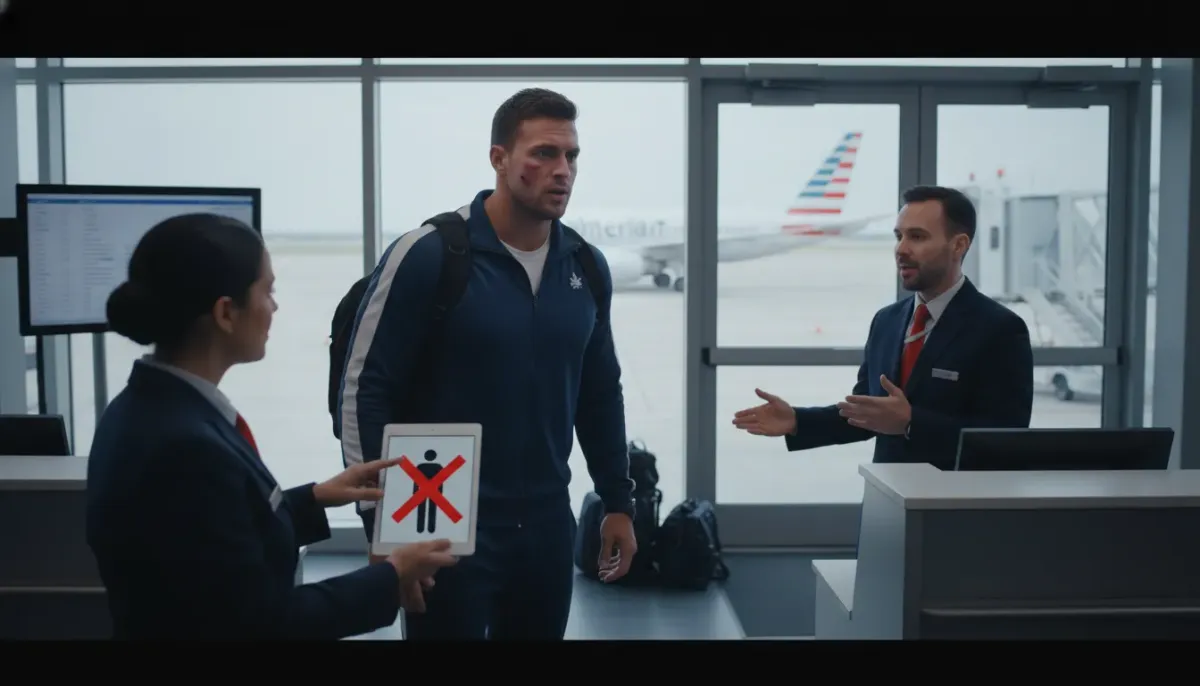
An unexpected incident unfolded on April 16 when American Airlines flight 513 made an unscheduled return to the gate at Los Angeles International Airport. The flight, bound for Philadelphia, encountered a situation involving passengers who failed to comply with federal aviation safety regulations. This incident captured public attention due to the involvement of a prominent MMA competitor and his associates, raising important questions about passenger conduct and airline safety protocols.
What Happened on American Airlines Flight 513
The commercial flight was preparing for departure when crew members identified an issue that would ultimately prevent the aircraft from leaving the tarmac. As the plane began to taxi toward the runway, several passengers remained standing in the aisle instead of occupying their assigned seats. Flight attendants made multiple attempts to resolve the situation by instructing the passengers to return to their seats, as required by federal regulations and standard airline safety procedures.
When passengers refused to comply with these instructions, the crew faced a difficult decision. Rather than proceed with an unsafe situation, the decision was made to return to the gate at LAX. This course of action reflects the airline's commitment to maintaining safety standards throughout all phases of flight operation. Video footage of the incident later surfaced, documenting the removal of multiple passengers from the aircraft before the flight eventually departed with the remaining travelers.
The situation resolved relatively quickly, with the flight ultimately reaching its Philadelphia destination after the problematic passengers were deplaned. However, the incident served as a stark reminder of the importance of passenger cooperation with crew member directives during critical flight phases.
The Real Reason Behind the Removal
Initial reports suggested that the incident involved a passenger using a mobile phone during taxiing, a common violation of airline policies. However, the actual cause differed from these early accounts. The passengers, including the MMA fighter and his companions, were standing in the aisle while the aircraft was actively taxiing and refused to return to their assigned seats when instructed by crew members.
Federal aviation regulations mandate that all passengers remain seated and properly restrained during taxiing procedures. These rules exist for legitimate safety reasons grounded in aviation science. When an aircraft is moving on the ground, sudden movements or stops can occur unexpectedly. Passengers who are standing face significantly higher risks of injury from unexpected acceleration, deceleration, or course corrections. The crew's insistence on compliance with these rules was not arbitrary but rather a necessary enforcement of established safety protocols.
The passengers' refusal to comply with multiple requests from flight attendants ultimately left the crew with no alternative but to return to the gate and remove them from the flight. This action upheld the airline's safety standards and demonstrated that these requirements apply equally to all passengers, regardless of their status or background.
American Airlines' Official Statement
Following the public emergence of video footage documenting the incident, American Airlines released a formal statement addressing the situation. The airline emphasized that safety remains their highest priority and that all customers are expected to comply with crew member instructions while aboard their aircraft. This includes remaining seated during taxiing, a fundamental requirement for passenger protection.
The statement reflected the airline's standard operating procedures and their commitment to enforcing federal aviation regulations consistently. American Airlines stressed that compliance with safety protocols is non-negotiable and applies uniformly to all passengers. The airline's position highlighted the seriousness with which they treat such incidents, regardless of whether the passengers involved are public figures or private citizens.
The formal communication served to clarify the airline's perspective and reinforce that crew members have both the authority and responsibility to enforce safety requirements. American Airlines demonstrated that they will not hesitate to remove passengers who endanger the safety of the flight or disrupt established safety procedures.
The Immediate Aftermath and Its Impact
Four passengers, including the MMA fighter, were ultimately removed from flight 513. Once these individuals were deplaned, the aircraft proceeded normally to Philadelphia with the remaining passengers. The situation concluded relatively swiftly once the non-compliant passengers were removed from the aircraft.
The fighter's response to the situation became public through social media posts. He announced that he would be boarding a private flight instead, joking about the likelihood of encountering similar issues on the alternative aircraft. His lighthearted commentary acknowledged the inconvenience created by the incident while accepting the consequence of the airline's decision. He noted that the private flight would add approximately five hours to his travel time, a significant delay given his scheduled commitment.
The incident demonstrated how quickly situations can escalate when passengers decline to follow crew instructions and how airlines respond to maintain safety standards. The fighter's decision to charter private transportation reflected his determination to reach his destination despite the setback.
Racing Against Time to RAF 8
The timing of this incident carried particular significance for the MMA fighter involved. He was traveling to Philadelphia to compete in a major MMA event where he held a prominent role on the fight card. His scheduled matchup was positioned as the co-main event, indicating his importance to the promotion's event. Missing this flight could have potentially jeopardized his ability to compete.
This was not the fighter's first appearance at the promotion. He had previously competed multiple times at the organization, demonstrating his status as an established competitor. His previous matchups against other notable fighters had made him a recognized name in the lightweight division. The high-stakes nature of his upcoming bout made timely arrival in Philadelphia essential for fight preparation and weigh-in procedures.
The charter flight arrangement ensured that he could still make his fight commitment despite the commercial flight setback. However, the additional travel time and the disruption to his pre-fight routine represented genuine inconvenience in the days leading up to his important competition.
What This Incident Reveals About Flight Safety
This incident serves as an important illustration of why airlines enforce taxiing regulations with such consistency and rigor. Federal aviation regulations regarding passenger conduct during aircraft movement are not suggestions but legally mandated safety requirements. These rules exist because they address real, documented safety risks that have emerged from decades of aviation experience.
When an aircraft is taxiing, pilots must maintain precise control of the vehicle while navigating complex airport environments. Passengers standing in aisles can suddenly fall if the aircraft encounters unexpected movement. The crew must enforce these regulations consistently with every passenger to maintain an established safety culture aboard the aircraft. When exceptions are made for passengers of any status, it undermines the safety system that protects everyone on board.
Airlines take these responsibilities seriously because passenger safety during flight operations is their primary obligation. The incident involving the MMA fighter, while notable due to his public profile, represents exactly the type of compliance issue that airlines must address immediately and consistently to maintain proper safety standards.