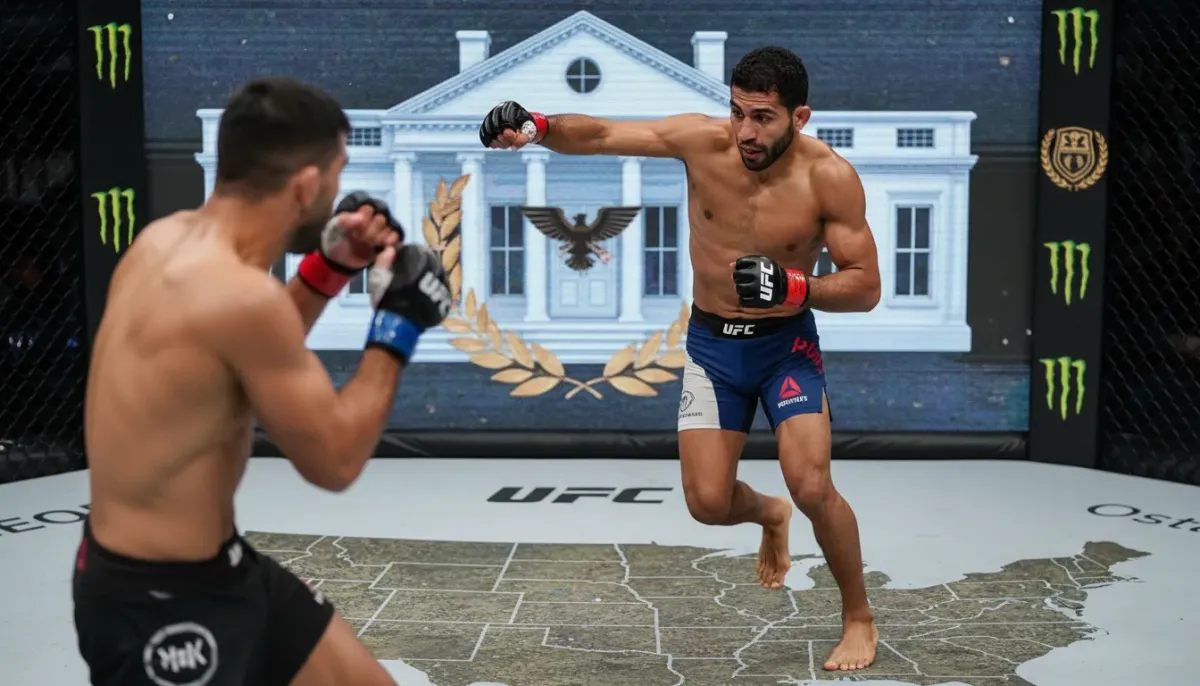
Charles Oliveira has set his sights on a decisive conclusion in his upcoming rematch with Max Holloway, driven by more than just reclaiming the BMF title. The Brazilian fighter is strategically eyeing a spot on the prestigious UFC White House card scheduled for June 14, and he understands that timing is everything. A quick victory would position him perfectly to transition directly into this historic event, combining both immediate success and long-term career advancement.
The Historic White House Card: A Fighter's Ultimate Dream
What Makes the White House Event Special
The upcoming UFC White House event represents a watershed moment in mixed martial arts history. Competing at such a prestigious governmental venue elevates a fighter's profile far beyond typical sporting achievements, transforming the event into a career-defining milestone. For athletes in combat sports, the opportunity to perform at this level of prestige carries implications that extend well beyond championship belts or rankings.
This isn't merely another pay-per-view card. The combination of mainstream attention, political significance, and the exclusive nature of the event makes it a once-in-a-lifetime opportunity for most fighters. The stakes encompass legacy building, mainstream credibility, and validation on a platform few in the sport ever access. Athletes recognize that their performance at such an event becomes woven into their permanent historical record.
Oliveira's Strategic Timeline
Oliveira's public comments about wanting a "quick" finish against Holloway aren't simply expressions of confidence—they reflect calculated strategic thinking. By eliminating his opponent efficiently at UFC 326, he positions himself with adequate recovery time and maintains momentum leading into the White House card.
The timing advantage of a swift conclusion cannot be overstated. A fighter who finishes quickly avoids the cumulative damage of extended rounds, preserves cardio for future commitments, and maintains psychological momentum. Oliveira's explicit goal of ensuring the fight ends soon demonstrates his understanding that logistical and physical preparation require adequate spacing between high-level competition.
The BMF Championship Quest: More Than Just a Belt
Understanding the BMF Title Context
The BMF championship occupies a unique space within modern MMA. Unlike traditional belts determined through structured rankings and mandatory challengers, this title celebrates fighting spirit, entertainment value, and the intangible qualities that resonate with audiences. For fighters, winning this championship signifies recognition beyond technical credentials—it acknowledges their impact on the sport's culture and entertainment landscape.
Oliveira and Holloway, both respected figures in their respective weight classes, bring considerable legitimacy to this title competition. Their bout carries genuine weight despite not being a conventional championship fight. The BMF belt represents peer recognition and fan appreciation in ways that standard titles sometimes cannot, making it a meaningful achievement regardless of divisional ranking.
Oliveira's Path Back to Lightweight Gold
While the BMF title provides immediate competitive opportunity, Oliveira hasn't abandoned his broader championship aspirations. The lightweight division continues evolving, with Ilia Topuria holding gold and interim champion Justin Gaethje representing another pathway. A successful defense or acquisition of the BMF belt strengthens Oliveira's positioning within these dynamics.
Victory against Holloway accomplishes multiple objectives simultaneously: it captures the BMF crown, maintains his status among elite lightweights, and generates momentum that cannot be ignored by divisional leadership. Oliveira recognizes that success builds upon success, and dominating Holloway amplifies his claim to future title opportunities.
Breaking Down Oliveira's Grappling Dominance
A Submission Specialist Unlike Any Other
Oliveira's submission record stands as one of the most impressive achievements in UFC history. With 17 tapout victories earned inside the octagon, he has established himself as the organization's preeminent submission specialist. This extraordinary statistic extends far beyond simple wrestling competence—it demonstrates exceptional technique, efficiency, and an almost intuitive understanding of positional leverage.
His notable victims include formidable competitors like Michael Chandler and Beneil Dariush, fighters respected for their defensive capabilities and grappling acumen. Achieving submissions against such caliber opponents validates that Oliveira's dominance isn't circumstantial but rather a product of elite-level technical mastery. This accomplishment becomes his primary weapon.
Holloway's Reluctance to Engage on the Mat
Oliveira expressed confidence that Holloway would deliberately avoid seeking grappling exchanges, regardless of fight circumstances. This assessment reflects understanding both of Holloway's stylistic preferences and the psychological reality of facing an unparalleled submission threat. Few fighters willingly surrender positional advantage to someone possessing Oliveira's ground credentials.
The psychological warfare here operates subtly but powerfully. When one competitor possesses such overwhelming advantage in a specific domain, it constrains the opponent's tactical options and mental approach. Holloway's reliance on striking prowess and strategic exchanges means abandoning the mat becomes a defensive necessity, even if grappling might otherwise serve his interests.
The Training Camp Mindset: Chute Boxe Diego Lima
What Separates Elite Teams from the Rest
Oliveira's attachment to Chute Boxe Diego Lima reflects more than simple gym loyalty—it represents immersion in a philosophical approach to fighter development. His colorful descriptions of training intensity, invoking imagery of suffering and relentless preparation, communicate how elite camps cultivate mental toughness alongside technical proficiency.
The reputation Chute Boxe has established within international MMA circles speaks to consistent production of technically sound, mentally prepared competitors. Oliveira's reference to training conditions so demanding that "the mother cannot help the child" illustrates how institutional culture shapes fighter psychology. This environment breeds adaptability and pain tolerance that translates directly to octagon performance.
Readiness for All Exchanges
Despite Holloway's recognized striking prowess, Oliveira expressed confidence in his ability to engage in standing exchanges. This assertion doesn't dismiss Holloway's technical capabilities but rather reflects preparation encompassing all combat domains. A fighter trained through such intensive methodology develops competence across multiple ranges.
Oliveira's readiness for standing combat, combined with his submission dominance, creates a complex opponent for any challenger. The absence of clear stylistic vulnerabilities forces opponents to navigate uncertainty and adapt throughout competition, rarely ideal circumstances for executing game plans under championship-level pressure.
The Striking vs. Grappling Dynamic
Respecting Holloway's Well-Rounded Skillset
Oliveira acknowledged Holloway's experience and versatility, demonstrating appropriate respect for an accomplished veteran. "The Blessed Express" has built his reputation through multifaceted fighting approaches and ability to succeed across different strategic scenarios. Underestimating such a competitor would represent dangerous overconfidence.
Holloway's striking arsenal remains genuinely threatening. His volume, precision, and cage control have troubled elite opposition throughout his career. Acknowledging these strengths while simultaneously expressing confidence in one's own capabilities requires nuanced assessment—recognizing opponent excellence without surrendering conviction in personal preparation.
Oliveira's Knockout Power as Standalone Threat
Beyond grappling dominance, Oliveira has demonstrated legitimate knockout capability, claiming four UFC victories through strikes. This layered offensive arsenal prevents opponents from developing singular counter-strategies. When a fighter threatens effectiveness across multiple domains, defensive preparation becomes exponentially more complicated.
The possibility of a striking finish before grappling engagement becomes relevant adds unpredictability to Oliveira's approach. Combined with his submission prowess, he presents genuinely comprehensive offensive threat that demands respect across all distance ranges and fight phases.
The Mind Games and Verbal Sparring
Social Media Exchanges and Playful Jabs
Modern MMA promotion inevitably incorporates social media engagement and public exchanges between competitors. Oliveira referenced video content where he playfully pointed to the ground, which Holloway apparently reciprocated with his own grappling posts. Such interactions, while maintaining entertaining tone, serve legitimate promotional purposes and generate audience interest.
These exchanges, though presented humorously, communicate confidence and tactical assessment. Fighters use platforms to shape narratives and signal readiness, blending entertainment value with genuine competitive communication. The audience engagement generated through such interactions benefits both competitors and the sport's mainstream visibility.
Confidence Without Arrogance
Oliveira's declarations about Holloway's tactical approach—specifically his assertion that Holloway won't invite him to the ground—demonstrate measured confidence grounded in technical reality. This differs from baseless trash talk; instead, it reflects analytical assessment of opponent strengths, weaknesses, and likely strategic preferences given circumstances.
Such confidence, when supported by legitimate accomplishment and technical superiority in relevant domains, translates effectively into fight performance. Entering competition with clear understanding of likely tactical exchanges and personal preparation provides significant psychological advantage, allowing focus on execution rather than adaptation to surprise approaches.