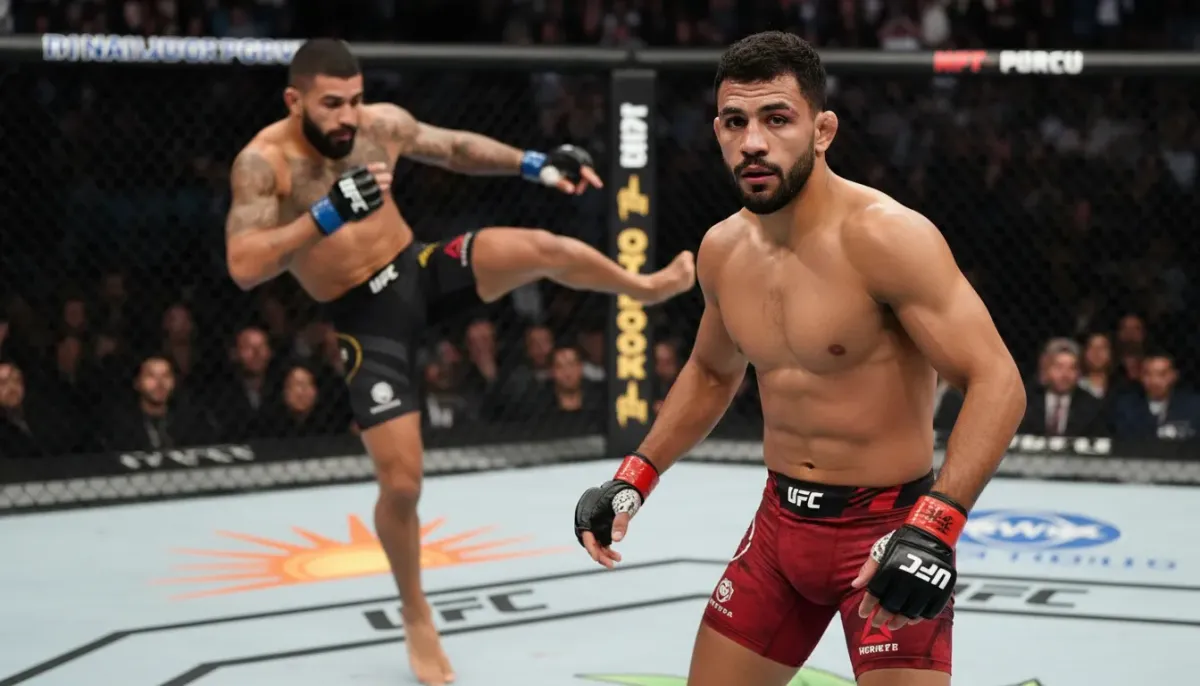
At nearly 39 years old, Raoni Barcelos finds himself in a precarious position within the UFC's bantamweight division. Time is not on his side, and the Brazilian fighter knows it. With a scheduled bout against Montel Jackson at UFC Vegas 116 on April 25, Barcelos recognizes that this moment represents a critical juncture in his career—one that demands calculated aggression and strategic target selection for his next opponent.
A Fighter Running Out of Time: The Urgency Behind Barcelos' Next Move
The mathematics of athletic longevity have never been kinder to fighters approaching 40. Barcelos, turning 39 just days after his UFC Vegas 116 appearance, operates with full awareness that his championship window continues to narrow. His current four-fight winning streak—victories over Payton Talbott, Cody Garbrandt, Ricky Simon, and Cristian Quinonez—demonstrates he remains competitive against quality opposition, yet his ranking position at 13 reflects how quickly momentum can dissipate without strategic advancement.
Unlike younger fighters with years to recover from setbacks or rebuild after losses, Barcelos cannot afford extended negotiations or period of inactivity. Each fight represents an opportunity to either climb the rankings decisively or risk falling back into the developmental tier. This urgency shapes not just his performance in the octagon, but his entire approach to opponent selection moving forward. The fighter has identified two primary targets who could accelerate his ascent: Marlon Vera and Deiveson Figueiredo.
The Montel Jackson Challenge and Beyond
Setting the Stage at UFC Vegas 116
Jackson serves as Barcelos' immediate objective on the UFC Vegas 116 card at the Meta APEX venue. This matchup functions as both a measuring stick and a launching pad. A victory here validates Barcelos' winning streak against meaningful competition while positioning him for a significant jump in opposition quality. The Jackson fight, therefore, operates as a necessary prerequisite to the larger ambitions that follow.
The Two-Name Call-Out Strategy
Barcelos has identified Marlon Vera as an initial option, though circumstances complicate this particular pursuit. Vera's current trajectory includes a three-fight losing streak, which raises questions about the mutual benefits of such a matchup. While a victory over a former top-ranked contender carries weight, facing a fighter in decline offers limited upside for ranking advancement.
This reality positions Deiveson Figueiredo as the more strategic choice. The former UFC flyweight champion remains ranked within the top seven of the bantamweight division, making him the type of opponent capable of delivering the significant jump in ranking status that Barcelos desperately requires at this stage of his career.
The Case for Figueiredo: A Calculated Campaign
Respect Across the Border
Notably, Barcelos approaches the prospect of calling out a fellow Brazilian fighter with deference and measured professionalism. He has followed Figueiredo's career for years and expresses genuine respect for both the fighter and his affiliation with the renowned Pitbull Brothers camp. This contrasts sharply with the manufactured drama and trash talk that characterizes much of modern MMA promotion.
Barcelos operates on a different wavelength, preferring substance over showmanship. His willingness to call out Figueiredo despite being a countryman demonstrates that competitive pragmatism supersedes national loyalty in his decision-making process. As he explained, the timing of his career demands that he pursue the fights most likely to advance his positioning, regardless of personal relationships or cultural considerations.
The Numbers Game
The mathematical case for pursuing Figueiredo is straightforward and compelling. Currently ranked 13th, a victory over a top-7 opponent would propel Barcelos into serious title contention territory. This represents not merely a incremental step forward but a significant leap that transforms his standing within the division. Such ranking advancement creates momentum that translates into negotiating power for subsequent matchups and increases the likelihood of faster progression toward championship opportunities.
Evaluating Figueiredo as an Opponent
Figueiredo's recent record tells a mixed story. Since relocating to bantamweight, he maintains a 4-3 mark, including victories over notable names like Marlon Vera, Cody Garbrandt, and Rob Font. His most recent performance saw him fall to Umar Nurmagomedov via decision, though he had defeated Jackson via split decision at the event in Rio de Janeiro where Barcelos observed the bout firsthand.
As an opponent, Figueiredo presents multi-dimensional challenges. His striking power remains significant, his jiu-jitsu demonstrates technical proficiency, and his wrestling capabilities add another layer of complexity. These factors combine to create the type of complete mixed martial artist that provides legitimacy to any victory, particularly one that advances ranking position.
Barcelos' Game Plan: Grappling as the Path to Victory
Leveraging Grappling Dominance
Should Barcelos secure the opportunity to face Figueiredo, his blueprint for victory centers on controlling the fight through wrestling and submission grappling. He acknowledges that his jiu-jitsu remains sharp and represents his most dangerous weapon, particularly when combined with effective takedown mechanics. Barcelos cites the success of fighters like Merab Dvalishvili, who have demonstrated that establishing dominance on the ground exhausts opponents and creates lasting conditioning advantages.
The Technical Breakdown
Barcelos approaches the technical challenges with clear-eyed assessment. Figueiredo's southpaw stance creates different angles and timing considerations that demand adaptation. However, Barcelos expresses confidence in his striking precision, suggesting his hands possess knockout potential if the fight remains standing. This balanced perspective—acknowledging both his preferred grappling path and his willingness to engage in exchanges—reflects a fighter who has studied his potential opponent extensively.
His stated strategy involves closing distance methodically, establishing control, and leveraging superior grappling acumen to dictate the fight's rhythm. Yet this plan includes built-in flexibility, with Barcelos maintaining readiness for any stylistic variation Figueiredo might present. The fighter's approach combines strategic specificity with tactical adaptability—a combination that separates experienced competitors from those still developing their craft.