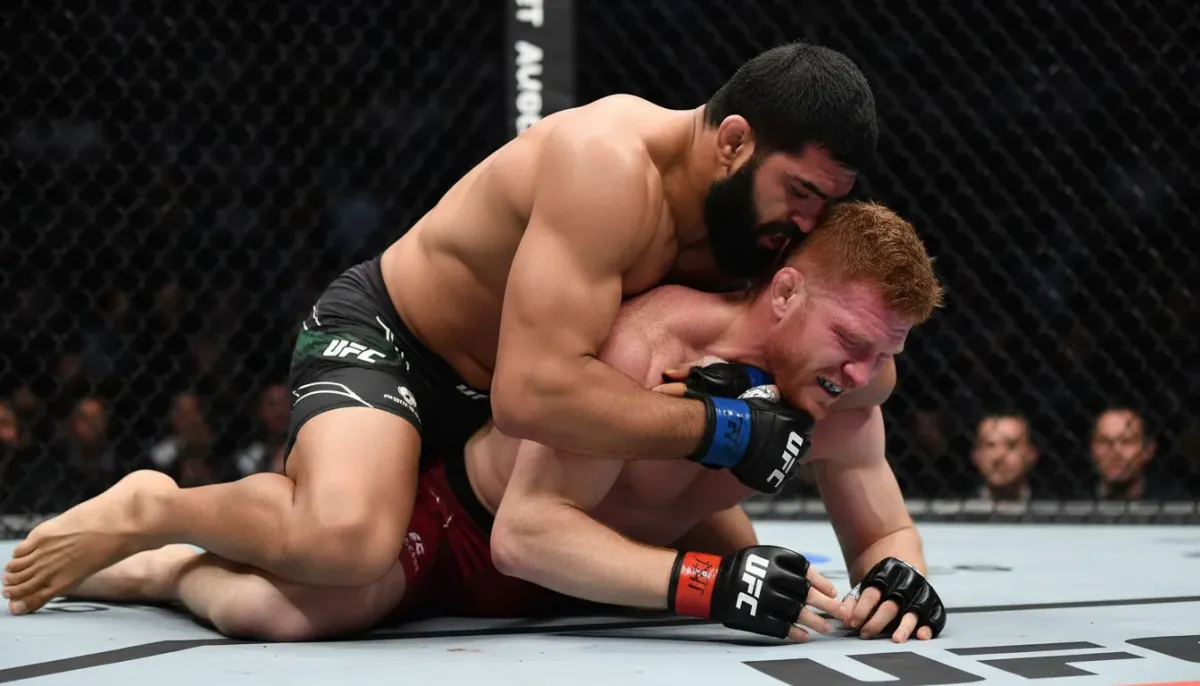
A Stark Size Difference Revealed
Dustin Poirier has faced some of the most formidable competitors in mixed martial arts history, yet his encounter with Islam Makhachev at UFC 302 left an indelible impression regarding physical disparity. When Poirier stood across the octagon from the lightweight champion that night, he was immediately struck by what he witnessed under the bright spotlights. The vascularity and overall mass of his opponent became unmistakably apparent, presenting a challenge unlike many others in his storied career.
Poirier's First Impression in the Octagon
The initial visual assessment proved telling. Poirier later recounted his raw reaction to seeing Makhachev's physique, noting the prominence of veins across his shoulders and the overwhelming sense of sheer size. This observation wasn't merely aesthetic commentary but rather recognition of the physical obstacle he was about to face. For a fighter who has competed against elite-level lightweights throughout his career, encountering such a pronounced physical specimen at the championship level raised immediate questions about the fairness of the matchup.
The Weight Gap Nobody Expected
What Poirier discovered months after their battle provided concrete evidence of the disparity he had sensed. During a conversation with UFC officials who maintain detailed fight-night weight records, Poirier learned the shocking truth: Makhachev had weighed approximately 190 to 192 pounds when stepping into the octagon, while Poirier came in at just 176 pounds. This represented a 14 to 16-pound advantage for Makhachev at a division contractually established at 155 pounds. The revelation highlighted a significant physical advantage that likely contributed substantially to the outcome of their championship encounter.
Understanding Makhachev's Championship Path
The Lightweight Title Reign
Makhachev's reign as the UFC lightweight champion was characterized by dominance and consistent calls for moving up in weight. Throughout his tenure defending the title, he repeatedly voiced concerns about the physical toll of cutting weight to the 155-pound limit. His naturally larger frame made maintaining that weight class increasingly challenging, and many observers recognized that his physical attributes were better suited for a heavier division. Despite the difficulties, he maintained his position at the top of the lightweight ranks with impressive performances.
The Welterweight Era Begins
The transition to welterweight proved to be the natural progression everyone anticipated. Shortly after his encounter with Poirier, Makhachev made the official move to 170 pounds, where his physicality could be fully realized without the arduous weight-cutting process. His welterweight debut campaign was nothing short of dominant, culminating in a commanding victory over Jack Della Maddalena for the championship. That five-round performance demonstrated that Makhachev had finally found his true division, where his size and strength could be deployed without compromise.
Decoding the Submission That Ended It All
The Brabo Choke Breakdown
The finish that determined the outcome of the Poirier fight wasn't a conventional submission, and Poirier provided detailed technical analysis of what transpired. The choke Makhachev employed resembled a D'arce submission in principle but differed significantly in execution. Rather than securing the grip around the bicep in traditional fashion, Makhachev locked his forearm directly against Poirier's neck, creating a unique angle that made standard defensive strategies ineffective. This technical variation proved crucial because it eliminated the escape routes that typically exist in more common choking positions.
The Immediate Effects of Perfect Technique
What distinguished Makhachev's submission was its immediate effectiveness. Poirier described the sensation of instantaneous blood cutoff rather than the gradual fading that usually accompanies such submissions. Once Makhachev secured the complete grip, the darkness descended rapidly, leaving virtually no opportunity for escape or recovery. Poirier noted that even attempts to create space by moving his legs or rotating his body proved futile against the unyielding pressure. Remarkably, Moicano had experienced the exact same submission technique from Makhachev, suggesting this is a signature finisher in his grappling arsenal.
Why Size Amplifies Technical Superiority
The combination of Makhachev's technical proficiency with his substantial physical advantages created an nearly insurmountable problem. His superior strength made the already-effective technique exponentially more dangerous. When a fighter possesses both exceptional technical knowledge and the muscular development to execute it with authority, the margin for error in defense becomes negligible. Poirier's inability to generate sufficient space or find viable escape routes spoke to the compounded effect of facing someone who excelled in all three categories: size, strength, and technique. This represents the complete fighter archetype that makes championship-level grapplers so difficult to overcome.
Fighting of the Night Recognition
Earning Respect Despite Defeat
Despite suffering a submission loss, Poirier's performance garnered significant recognition. He managed to extend the bout to the fifth round, a considerable achievement considering the physical disadvantage he faced throughout. The Fight of the Night honors reflected the quality and intensity both competitors brought to their contest, suggesting that while Poirier ultimately fell short, his efforts remained competitive and impressive. This recognition underscored that a loss doesn't necessarily diminish a fighter's credibility when they face such formidable opposition under unfavorable circumstances.
A Building Resume for Makhachev
For Makhachev, victories over top-tier competition like Poirier significantly enhance his historical standing in the sport. The ability to defend a lightweight title against multiple-time championship contenders, then transition successfully to welterweight and claim that title as well, places him among the most impressive modern fighters in MMA. Each dominant performance adds another notable entry to his resume, building a legacy defined by consistent dominance across multiple weight classes. The manner of his victories, characterized by technical excellence and overwhelming control, further solidifies his position as one of the elite competitors in contemporary mixed martial arts.
The Broader Context of Weight Management in MMA
Cutting Weight vs. Natural Advantages
The Makhachev-Poirier situation illuminates a persistent challenge within professional MMA: the reality of weight-cutting practices at championship level. Fighters regularly come in significantly above their contracted weight class, sometimes by margins that seem to contradict the purpose of weight divisions. Makhachev's case represents an extreme example, but it raises legitimate questions about fighter safety and competitive fairness. The debate extends beyond individual matchups to encompass broader concerns about how weight management should be regulated and monitored in professional combat sports.
What This Means for Future Competition
Makhachev's successful repositioning at welterweight validates the strategic decision to move where his natural frame could be fully utilized. His continued dominance at the higher weight class suggests that many lightweight competitors might similarly benefit from upward mobility. This transition creates ripple effects throughout the lightweight division, potentially reshaping competitive landscapes as elite-level fighters reassess their optimal weight classes. For fighters considering similar moves, Makhachev's blueprint demonstrates that such transitions, when executed thoughtfully, can lead to continued championship success and elimination of the grueling weight-cutting process.