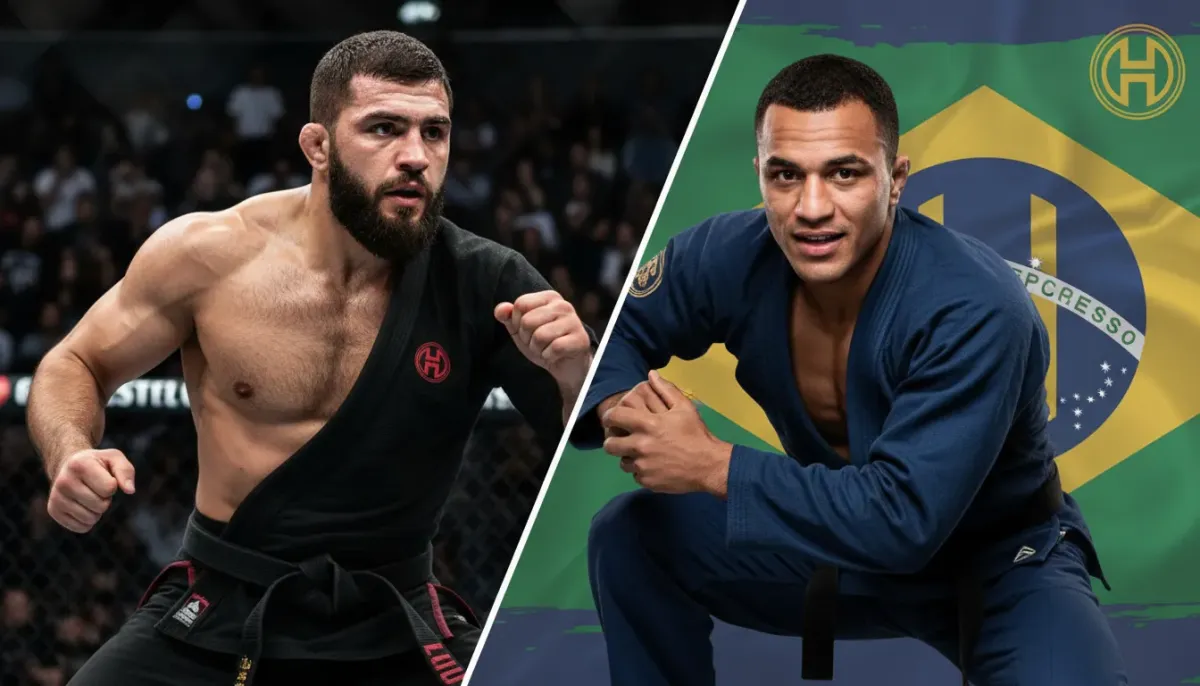
When Elite MMA Fighters Step Into the Grappling Ring
The world of combat sports has witnessed a fascinating trend in recent years, with top-tier mixed martial artists increasingly exploring specialized submission grappling competitions. These athletes, accustomed to balancing striking, wrestling, and submissions, discover unique challenges when stepping into a pure grappling environment. The upcoming clash between Arman Tsarukyan and Muhammad Mokaev at Hype Brazil in Rio de Janeiro represents precisely this dynamic—a 10-minute submission-only bout that showcases why elite competitors continue diversifying their combat sports portfolios.
Tsarukyan's Journey Into the Grappling Arena
From UFC Lightweight Contender to Submission Specialist
Tsarukyan has strategically repositioned himself in the competitive landscape after finding himself outside the immediate UFC lightweight title picture. Rather than remaining idle, he has channeled considerable energy into submission grappling events, demonstrating a serious commitment to expanding his skillset. Throughout the previous year, he accumulated multiple competition appearances at various specialized grappling venues, including recent RAF event participation. This deliberate pursuit reveals an athlete determined to remain sharp, stay competitive, and explore new competitive avenues while maintaining his elite status in combat sports.
Why Elite MMA Fighters Are Turning to Grappling
The broader trend of accomplished MMA fighters competing in specialized grappling formats reflects a strategic approach to athletic development. These events offer several advantages: opportunities to isolate and refine specific technical skills, maintain competition rhythm during promotional downtime, generate additional income, and test themselves against pure grappling specialists. For fighters like Tsarukyan, such competitions serve as valuable training laboratories where they can stress-test their wrestling without the added complexity of striking defense. This diversification strategy has become increasingly common among elite athletes seeking to remain engaged with their craft.
Mokaev's Redemption Arc: From UFC Star to Independent Competitor
The Departure and What Came After
Muhammad Mokaev's departure from the UFC marked a significant transition in his professional career. Despite maintaining a perfect 7-0 record within the promotion, the organization declined to extend his contract, prompting the talented flyweight to explore opportunities elsewhere. Since that departure, Mokaev has demonstrated remarkable resilience, securing three additional victories with other MMA organizations while extending his professional record to an impressive 10-0. This undefeated status across multiple promotions underscores his capabilities as a complete MMA fighter, proving that success extends far beyond the UFC's organizational boundaries.
The Grappling Reality Check
However, Mokaev's flawless MMA record starkly contrasts with his submission-only grappling experience. Entering this matchup, he carries a 0-2 record in pure grappling competitions from the previous year, highlighting a crucial reality for mixed martial artists: excellence in MMA does not automatically translate to success in specialized grappling formats. The differences run deep—from positional priorities to submission setups to the absence of striking threats. Mokaev faces an uphill battle not only due to Tsarukyan's experience and size advantage but also because he must overcome demonstrated weaknesses in this specific discipline.
The Size Factor: Expected Dynamics and Advantages
Beyond Weight Class Differences
While Tsarukyan operates at lightweight and Mokaev at flyweight, the actual physical disparity observed at the weigh-ins proves less dramatic than one might initially expect from these weight classes. Tsarukyan possesses a noticeable advantage in size and body composition thickness, yet the gap remains less pronounced than typical weight class jumps would suggest. This reality matters significantly in grappling, where body density, muscle distribution, and overall athleticism often prove as important as absolute size. Understanding these nuances helps contextualize how each competitor might leverage or compensate for physical differences during their ten-minute encounter.
Technical Expectations and Pressure Dynamics
In submission-only grappling, size advantages typically manifest through superior positional control and sustained pressure application. Tsarukyan's greater mass should enable him to establish and maintain top position more effectively, particularly when transitioning through guard passes and mounting sustained side control. Conversely, Mokaev must compensate through superior speed, technical efficiency, and strategic guard maintenance. His survival strategy likely centers on rapid guard recomposition, effective underhook placement, and keeping Tsarukyan from achieving statically dominant positions. The matchup essentially pits power and control against mobility and technique.
Match Breakdown: Round-by-Round Analysis
Opening Exchanges and Positional Wrestling
The bout commenced with Tsarukyan immediately imposing his will through aggressive positioning work. He established a front headlock sequence early, successfully bringing Mokaev to the mat before the more elusive competitor escaped to his feet. Tsarukyan then transitioned to bodylock control, forcing Mokaev into a defensive roll that nonetheless allowed Tsarukyan to maintain top-half guard position. Mokaev's early defensive strategy relied on underhook placement and rapid guard recomposition, preventing Tsarukyan from achieving dominant mount or side control immediately. These opening sequences established the fundamental dynamic: Tsarukyan seeking sustained top pressure while Mokaev emphasized constant motion and positional resets.
The Mid-Match Grind: Control vs. Evasion
The middle portion of the match showcased Tsarukyan's relentless top pressure against Mokaev's increasingly taxed defensive system. Tsarukyan cycled through repeated smash passes to half-guard, attacking first one leg then the other, while Mokaev deployed knee shields and butterfly hooks to prevent full guard passage. The pattern repeated across multiple sequences: Tsarukyan advancing to side control, Mokaev rolling to his knees or back, Tsarukyan reestablishing the front headlock, and the cycle continuing. Though Mokaev's technical defense remained sharp, he visibly slowed as the match progressed, his escapes becoming slightly less explosive and his recompositions marginally slower.
The Decisive Moment: Back Control and Finishing Sequence
The match's turning point arrived when Tsarukyan successfully transitioned through mount position and initiated a D'Arce choke setup. Mokaev initially recognized the threat and turned back, but Tsarukyan maintained relentless offensive pressure, constantly adjusting angles and maintaining top control. As Mokaev's energy visibly depleted, Tsarukyan transitioned to side control with ease, then ultimately achieved back control with chin-underneath positioning. At this critical juncture, with Tsarukyan securing dominant back position and establishing under-chin control, Mokaev faced an extremely limited window for escape, effectively conceding the match's decisive advantage to his more controlling opponent.
Technical Lessons From the Matchup
The Effectiveness of Smash Passing in No-Gi Grappling
Tsarukyan's repeated deployment of heavy top pressure and smash passing techniques proved particularly effective in the no-gi environment. Without traditional gi gripping options, his ability to clear legs through sheer pressure and positional control became paramount. This approach relies on sustained weight distribution, continuous pressure maintenance, and rapid leg-clearing sequences that prevent guard recomposition. The strategy demonstrates why no-gi grappling often rewards heavier, stronger competitors who can implement relentless pressure-based passing systems, a principle equally applicable to MMA ground control situations.
When Speed and Efficiency Meet Overwhelming Pressure
Mokaev's defensive strategy highlighted how speed and technical efficiency can partially counteract overwhelming pressure, yet with limitations. His ability to recompose guard repeatedly and escape adverse positions extended the match far longer than pure size advantages would suggest. However, this tactical approach eventually succumbs to fatigue when opponents maintain relentless pressure without mistakes. The lesson proves clear: while technical excellence and mobility provide valuable defensive tools, they cannot indefinitely overcome sustained, intelligent pressure from a stronger, similarly skilled opponent.
What This Victory Means Moving Forward
Tsarukyan's Continued Evolution as a Complete Combat Athlete
Tsarukyan's successful performance reinforces his status as a multidisciplinary combat athlete capable of competing effectively across different grappling formats. This victory adds credibility to his submission-only credentials while potentially influencing future negotiations or competitive opportunities. Whether this success influences his standing in future UFC discussions or simply establishes him as a legitimate grappling competitor remains to be seen, but the demonstration of control and technical execution against a previously undefeated MMA fighter carries undeniable significance.
Mokaev's Path Forward in New Territories
For Mokaev, this result extends his grappling difficulties to 0-3, necessitating genuine strategic consideration about his competitive future. Whether he intensifies grappling-specific training to address technical gaps, refocuses entirely on MMA competition, or seeks specialized coaching for pure submission wrestling becomes increasingly important. The contrast between his undefeated MMA record and struggling grappling performance suggests that specific, targeted development in submission-only formats may prove necessary if he chooses to continue pursuing this avenue.