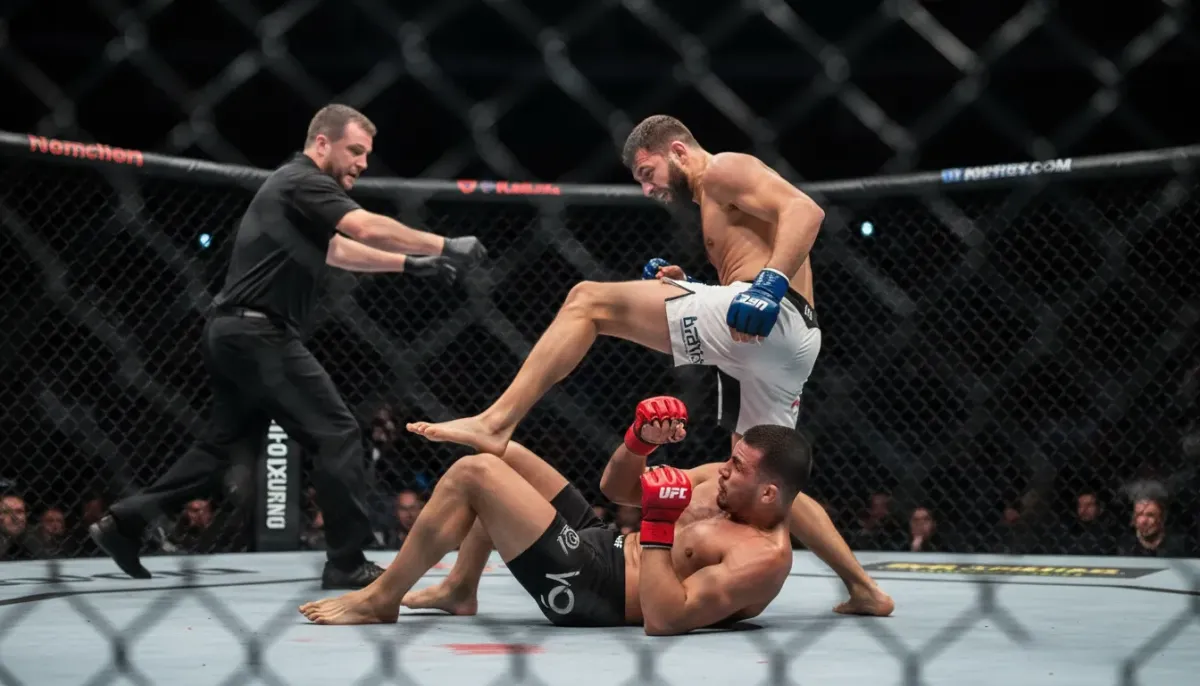
In a moment that left the MMA community questioning the consistency of officiating decisions, Dione Barbosa delivered a devastating illegal soccer kick during her UFC Vegas 115 matchup against Melissa Gatto, yet managed to escape with only a one-point deduction before securing a majority decision win. This controversial sequence raised important questions about how the promotion enforces its regulations and protects fighter safety.
The Shocking Moment That Changed Everything
The critical incident unfolded during the second round at the Meta APEX, when the fight took an unexpected and contentious turn. Gatto found herself in a vulnerable position on her back, attempting to regain her footing as she worked to escape the bottom position. At this critical juncture, Barbosa unleashed a massive soccer-style kick that reverberated throughout the venue with startling force.
The impact was immediately devastating. Gatto's body spun backward across the canvas, and she appeared to lose consciousness momentarily from the force of the blow. Referee Chris Tognoni quickly intervened, pausing the action to assess the situation. The arena fell silent as officials and corner personnel evaluated Gatto's condition, with genuine concern about her ability to continue.
The broadcast captured the sheer violence of the moment, with replays showing the full extent of the contact and Gatto's apparent knockout state. This split-second decision point would ultimately determine the trajectory of the entire contest.
Breaking Down the Illegal Strike
What Made the Kick Illegal
Under UFC regulations, the legality of strikes against grounded opponents is determined by specific body position criteria. A fighter is considered grounded when their hand or shin makes contact with the canvas, at which point certain offensive techniques become prohibited. This rule exists to prevent unnecessary brutality and protect fighters from exploitation while they're in vulnerable positions.
In this instance, commission officials reviewed the footage and confirmed that Gatto's hand and shin were both in contact with the ground at the moment of impact. This clear contact made the soccer kick an indisputable violation of the ruleset, regardless of intent or the consequences that followed.
The Immediate Aftermath
Following the impact, Gatto remained motionless on the canvas in what appeared to be an unconscious state. The apparent severity of her condition prompted Tognoni to pause the action immediately. Officials gathered around the fighter while the medical team stood ready, creating a tense situation where spectators genuinely wondered whether the fight would continue.
The brief moment of uncertainty hung over the Meta APEX as everyone awaited the next decision from the officiating crew.
The Five-Minute Review That Sparked Debate
Commission Officials' Decision-Making Process
Rather than issuing an immediate disqualification, commission officials undertook an extended five-minute review of the footage. This lengthy examination suggested that the decision-making process involved careful deliberation about the appropriate penalty. The replay analysis confirmed the illegal nature of the strike, yet the officials ultimately opted for a significantly lenient response.
Tognoni assessed only a one-point deduction as the punishment, a notably light penalty for what appeared to be a severe infraction. Disqualification, which would have been the maximum consequence, was not pursued despite the clear rule violation. This decision raised eyebrows throughout the MMA community, as observers questioned why such a flagrant foul didn't result in the harshest possible punishment.
Professional Reactions and Controversy
Following the incident, fighters and analysts debated the appropriateness of the ruling. Some professionals questioned whether Gatto had genuinely lost consciousness, suggesting her reaction might have been exaggerated. Others argued that the penalty was insufficient given the severity of an illegal strike that appeared to nearly end the contest.
The debate highlighted ongoing discussions within MMA about consistency in rule enforcement and whether penalties are applied uniformly across different situations and fighters.
Gatto's Remarkable Fight Back
The Resilience Factor
What followed was a testament to Gatto's mental and physical toughness. Despite appearing to be knocked out moments earlier, she returned to action and fought with genuine determination for the remainder of the bout. This recovery from such an apparent devastating impact showcased significant resilience, though questions remained about her full capacity after the trauma.
Gatto's ability to continue demonstrated the warrior spirit characteristic of professional combat athletes, even when facing overwhelming adversity during competition.
Barbosa's Controlled Approach
Once the action resumed, Barbosa adjusted her strategy effectively. Rather than seeking to press her advantage recklessly, she maintained control through solid grappling exchanges and avoided putting herself in positions where further controversy might occur. This measured approach allowed her to accumulate points without generating additional dangerous moments.
Barbosa's composed performance in the latter rounds demonstrated tactical awareness and the ability to control the fight's pace while managing risk.
The Scorecard Result and Career Implications
How the Judges Scored the Bout
When the final bell rang, the judges rendered scores of 28-28, 29-27, and 29-27 in favor of Barbosa, resulting in a majority decision victory. The split scorecard indicated that at least one judge saw the bout as competitive, while the other two favored Barbosa's overall performance. The controversial soccer kick and its one-point penalty clearly influenced how judges evaluated the competition.
What This Win Means for Both Fighters
Barbosa improved her UFC record to 3-2 with this victory, maintaining her position on the roster and her viability as a contender in her division. For Gatto, the loss brought her record to 3-3 inside the octagon, placing her at a critical juncture in her career where future performance will determine her trajectory within the organization.
The decision also carries implications for how future matchmakers view both fighters and their readiness for specific opponents, especially regarding their ability to handle adversity and high-pressure situations.
Broader Questions About UFC Enforcement
Beyond this specific incident, the UFC Vegas 115 moment raised fundamental questions about consistency in penalty application across the organization. When illegal strikes occur, the severity of the foul should logically correlate with the severity of the punishment, yet this case suggested that other factors influence decision-making.
The incident prompted reflection on how the promotion balances fighter safety protocols with competitive outcomes and whether current enforcement mechanisms adequately address the most egregious violations. As MMA continues to evolve, discussions about standardizing rule enforcement remain relevant to maintaining the sport's credibility and protecting athlete welfare.