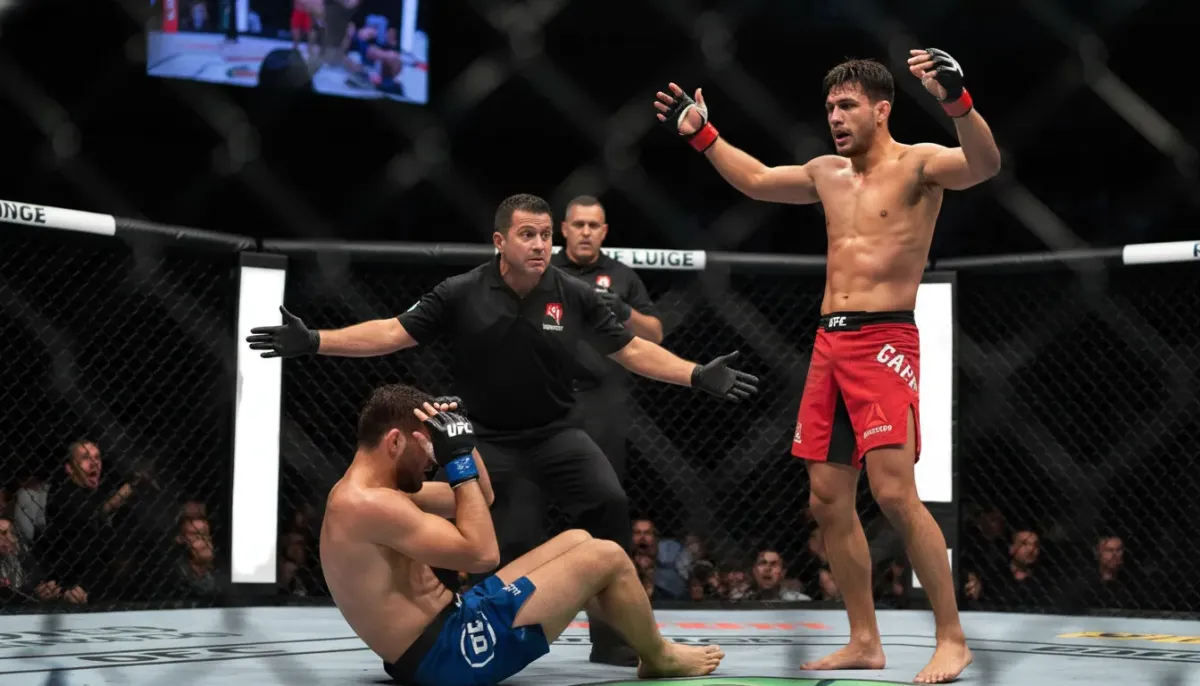
The Thumbs-Up Dilemma—A Brazilian Tournament Gone Wrong
Mixed martial arts officiating remains one of the most challenging aspects of competitive fighting. A recent incident in São Paulo perfectly illustrates the complexity and potential for confusion when referees make split-second decisions. During a welterweight tournament bout between Luciano Oliveira and Elismar Lima, a controversial stoppage raised serious questions about referee protocols and communication between competitors and officials.
The Guillotine Situation
Late in the first round, Oliveira secured a guillotine choke around Lima's neck—a dangerous position that typically signals trouble for the fighter being choked. However, Lima demonstrated remarkable composure throughout the ordeal. Rather than panicking, Lima maintained his positioning and appeared to be handling the situation adequately. With only seconds remaining in the round, Lima clearly gave a thumbs-up signal to indicate he was fine and wanted to continue fighting. Despite this explicit communication, referee Rodrigues inexplicably waved off the bout, handing Oliveira a first-round submission victory. The decision left observers confused and questioning the official's judgment.
Breaking Down the Ambiguous Moments
Analyzing the sequence reveals several interpretive challenges. When Oliveira first applied the guillotine, Lima's hand made contact with the mat twice. Whether these constituted actual submission taps or simply incidental contact during position adjustments remains debatable. Importantly, Rodrigues did not intervene at those moments, suggesting the official may not have interpreted them as deliberate taps. Lima continued adjusting his grip throughout the submission attempt and appeared to make defensive movements toward Oliveira's hip, though these actions were far from clear submission indicators. The most puzzling aspect is why the thumbs-up signal prompted immediate stoppage when earlier, more ambiguous hand movements did not trigger intervention. This inconsistency raises questions about referee positioning, communication clarity, and decision-making consistency.
Tournament Outcomes and the Bigger Picture
Despite the controversial nature of Oliveira's advancement, the tournament ultimately proceeded as expected. Yuri Popeye delivered a spectacular knockout over Guilherme Severo with a devastating striking combination. Popeye subsequently faced Oliveira in the tournament final and secured victory, becoming the tournament champion. While the questionable stoppage allowed Oliveira to progress, it did not ultimately determine the tournament's champion, suggesting the referee's error, though significant, did not change the final outcome.
Other Officiating Moments Worth Discussing
The Fence-Punching Non-Call
In an amateur featherweight bout at BTC 36 in Mississauga, Ontario, Bryan McCormick secured back control over opponent Justin Soroka and established a rear-naked choke. In his desperation to escape, McCormick resorted to double-fisting the cage—a move that typically draws immediate referee attention. However, referee Brian Beauchamp exercised restraint and allowed the action to continue. This decision proved justified, as Soroka was already in grave danger with no viable escape route. Sometimes, officials correctly recognize that the outcome is inevitable and that stopping the action becomes unnecessary. This example contrasts sharply with the Lima-Oliveira situation, demonstrating how proper referee judgment should balance fighter safety with fight continuity.
Swift Submissions and Striking Excellence
Lightning-quick finishes showcase the highest levels of combat athleticism. Starling Simmons required just 17 seconds to dispatch Jerrod Winston at Anthony Pettis FC 23, demonstrating explosive grappling efficiency. Miguel Sanson achieved victory in a comparatively longer 48 seconds, while Adriano Castro capitalized on an opponent's positioning error to secure a chokehold against Felipe Molina. Additionally, strawweight Jade Jorand delivered an impressive striking performance at Ares FC 39, showcasing aggressive striking combinations that highlighted her technical prowess across multiple combat disciplines.
Unexpected Drama Beyond the Octagon
When Nature Intervenes: The Tornado Warning Incident
Combat sports occasionally face challenges beyond fighter skill and referee decisions. At LFA 230 in Shawnee, Oklahoma, a tornado warning forced an unexpected evacuation of the Grand Casino Hotel & Resort. The entire venue lost power, threatening to derail the entire event. Fortunately, safety protocols functioned properly and no attendees or competitors suffered injuries. Once the immediate danger passed, event organizers successfully resumed competition, demonstrating resilience and professionalism. Despite the chaos, fighter Charlie Cleveland delivered a dominant performance over Bartling with aggressive ground-and-pound offense, ultimately proving that even nature's interruptions cannot dampen the fighting spirit of dedicated competitors.
Striking Excellence and Technical Precision
Global MMA promotions continue showcasing exceptional striking and counter-striking. At Open Fighting Championship 63 in Samara, Russia, Eduardo Souza executed a textbook kick catch and counter, demonstrating the technical mastery required at elite levels. Conversely, Shiokey Vargas at KO Showtime 10 in Chiclayo, Peru, attempted to block a kick with his face—a significantly less effective defensive strategy. Alexander Rojas experienced even greater misfortune when absorbing Piero Torres' devastating spinning elbow strike. Finally, Alexis De la Cerda delivered what many consider a knockout-of-the-year candidate in Zuffa Boxing, showcasing the striking excellence that transcends traditional MMA competition.
The Ongoing Conversation About MMA Officiating
The Oliveira-Lima stoppage exemplifies broader challenges within MMA officiating across global promotions. Referees must simultaneously prioritize fighter safety, respect explicit fighter communication, and maintain consistent standards across all bouts. The discrepancy between ignoring Lima's apparent hand contact on the mat while stopping the fight after his thumbs-up signal reveals inconsistent application of stoppage criteria. Moving forward, improved referee training, clearer communication protocols, and stricter positioning requirements could help eliminate such controversial decisions. As MMA continues expanding internationally, establishing consistent officiating standards becomes increasingly important for the sport's credibility and athlete welfare.