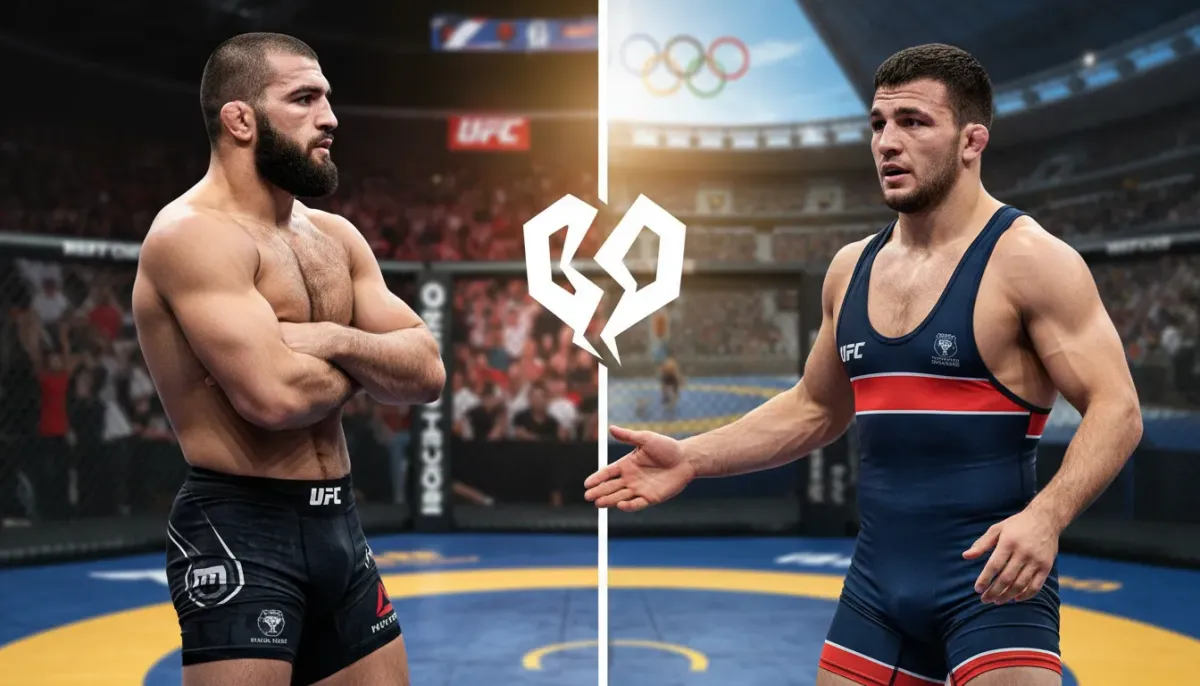
The Challenge That Never Was
When Olympic wrestling champion Kyle Snyder expressed his interest in facing Khamzat Chimaev in a wrestling match through RAF, the UFC middleweight contender had a straightforward response: it simply wasn't worth his time. While preparing for his title defense against Sean Strickland at UFC 328 and gearing up for his highly anticipated RAF debut, Chimaev made it clear that stepping into the wrestling ring with one of the world's elite grapplers didn't align with his current objectives. This decision, though it may have disappointed crossover combat sports fans, reflects a deeper understanding of what separates elite MMA wrestling from pure Olympic grappling. Chimaev's reasoning was both logical and candid, highlighting why these two competitive worlds, while interconnected, operate under fundamentally different parameters.
Understanding the Sport-Specific Gap
MMA Wrestling vs. Olympic Wrestling: Two Different Worlds
The distinction between wrestling for MMA and wrestling at the Olympic level represents one of the most misunderstood aspects of combat sports. While both disciplines require exceptional grappling prowess, the techniques, conditioning, and strategic focus diverge significantly. Olympic wrestling emphasizes specific movements perfected over thousands of repetitions, particularly techniques like double-leg takedowns that form the foundation of traditional wrestling. MMA wrestling, conversely, must integrate seamlessly with striking, submissions, and ground positioning while operating within a much smaller competition area.
Chimaev addressed this disparity directly, explaining that the years required to master Olympic wrestling techniques simply don't translate directly to MMA success. The skill sets overlap, but the application differs fundamentally. An elite Olympic wrestler competing in pure wrestling rules faces entirely different scoring systems, match duration, and strategic considerations than an MMA fighter operating within the octagon's constraints.
Chimaev's Honest Assessment
In his characteristic blunt manner, Chimaev revealed that he hadn't engaged in serious double-leg training in seven or eight years, noting that his last focused work on those specific entries occurred during training sessions with Arman Tsarukyan that were largely done in jest. This admission wasn't a sign of weakness but rather a reflection of where his training priorities have shifted. He explained his logic plainly: if his goal was to become an Olympic wrestling champion, he would have pursued that path entirely. Since his focus remains on UFC dominance, spending countless hours perfecting Olympic wrestling techniques would represent a misallocation of his training resources.
Chimaev's refusal of Snyder's challenge stemmed from this pragmatic assessment. Competing against elite wrestlers on their home turf, following their rules and emphasizing their techniques, would put him at a substantial disadvantage. His competitive philosophy centers on dominating within the MMA framework, where his overall skill set provides significant advantages over pure wrestlers who lack boxing and submission expertise.
Kyle Snyder's Respectful Counter-Argument
The Olympic Champion's Perspective
Snyder responded to Chimaev's decline with grace and understanding, fully acknowledging the mutual disadvantage principle that would govern any crossover competition. The Olympic champion recognized that his vulnerabilities in boxing and jiu-jitsu would be exposed in an MMA setting just as severely as Chimaev's wrestling deficiencies would become apparent in a pure wrestling match. This mutual respect for each discipline's complexity demonstrated the maturity with which Snyder approached the potential matchup. Rather than dismissing Chimaev's concerns, Snyder validated them while expressing his genuine interest in experiencing what competition against the UFC fighter would feel like.
Snyder's candor about his own limitations showed he wasn't approaching this as a guaranteed victory scenario. He acknowledged that in a hypothetical bout with limited rounds and no wrestling focus, his lack of boxing and jiu-jitsu training would likely result in significant disadvantage. This perspective revealed Snyder's deep respect for the comprehensive skill set required in MMA competition.
A Match Made in RAF?
While Chimaev declined the immediate opportunity, Snyder didn't entirely abandon hope for a future collaboration through RAF, the wrestling promotion where Chimaev recently signed. Snyder expressed genuine enthusiasm about potentially competing alongside Chimaev in the future, framing it as an exciting prospect rather than a current necessity. He acknowledged that the matchmakers involved in RAF—specifically mentioning Izzy Martinez and Chad Bronstein—possessed the persuasive abilities to potentially arrange such a crossover event, referencing how these promoters had previously convinced fighters like Uriah Faber to participate in wrestling matches.
Snyder's message to Chimaev was constructive: should the UFC fighter ever decide to pursue Olympic-level wrestling, he should first accumulate competitive experience through matches at intermediate levels before challenging the elite. This suggestion respected Chimaev's current focus while leaving the door open for future possibilities when the time might be more appropriate.
The Bigger Picture: Chimaev's UFC Focus vs. RAF Ambitions
Chimaev's immediate priorities paint a picture of an athlete managing multiple high-level commitments strategically. His UFC 328 title defense against Strickland represents his most pressing obligation, requiring complete focus on preparation for a middleweight champion clash. Simultaneously, his RAF debut looms as another significant venture into competitive wrestling, albeit within an MMA-sympathetic context where his skill set remains relevant.
These dual engagements explain why pursuing Olympic wrestling at Snyder's level simply didn't fit his timeline. Chimaev operates within a carefully managed schedule where every training hour must maximize his preparation for identifiable upcoming competitions. Allocating substantial time to a wrestling match that offered no immediate benefit to either his UFC title defense or RAF debut would represent a strategic misalignment. Instead, Chimaev's RAF competition will likely feature wrestlers who, like him, come from mixed martial arts backgrounds rather than elite Olympic wrestling lineage. This approach allows him to leverage his MMA wrestling advantages while maintaining focus on his primary professional objectives.
The Role of Matchmakers in Combat Sports Diplomacy
Can Promoters Make It Happen?
Snyder's reference to the persuasive power of promoters illuminates an important reality in combat sports: marquee matchups often happen because organizational leadership makes them happen. Matchmakers like Izzy Martinez and Chad Bronstein wield significant influence in determining which fighters compete against one another, sometimes convincing athletes to step outside their comfort zones for high-profile opportunities. Snyder's example of Uriah Faber wrestling Arman Tsarukyan demonstrated how promoters could facilitate crossover events that might not occur through athletes' individual initiative alone.
For a Chimaev-Snyder wrestling match to materialize, RAF's leadership would need to structure an attractive proposition that justified the commitment from both parties. The organization's recent track record of featuring UFC stars suggests they possess both the promotional platform and the resources to create compelling crossover events that appeal to combat sports enthusiasts.
What It Would Take
Snyder sensibly outlined the prerequisites for such a matchup: Chimaev would benefit from competitive wrestling experience at intermediate levels before challenging an Olympic champion. This staged approach would allow Chimaev to rebuild his wrestling-specific conditioning and technical proficiency, creating a more competitive scenario. The timeline for such a progression remains uncertain, particularly given Chimaev's current UFC commitments, but the possibility persists as a future option rather than an immediate impossibility.
Respect Across Disciplines
Perhaps most notably, the Chimaev-Snyder interaction reflected genuine mutual respect between athletes from different combat sports backgrounds. Both fighters share a fundamental competitive mentality: the desire to test themselves against the world's best and emerge victorious. Snyder admired Chimaev's approach to MMA, praising his attitude of seeking to dominate every opponent he faces. This philosophical alignment, despite their different specializations, created a foundation of respect that extended beyond their professional rivalry.
Their connection deepened through a shared training relationship with Coach Sam Calavitta, who worked with both fighters. This common mentor created an additional link between them and suggested that informal collaboration or knowledge exchange might occur outside formal competition. Ultimately, the refusal of Snyder's challenge didn't diminish the mutual admiration between two elite competitors who respect what the other has accomplished within their respective domains.